
Charles Darwin - Alfred Russel Wallace - Thomas Malthus
with key quotes
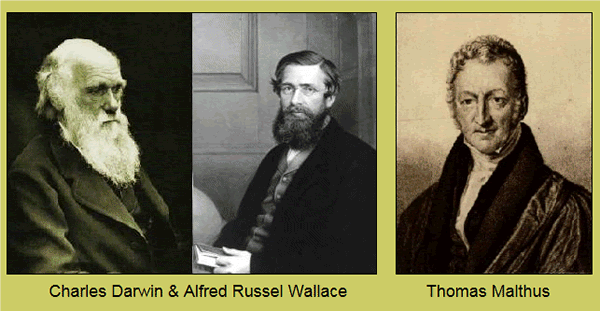
The Introduction to the first, 1859, edition of Charles Darwin's 'Origin of Species' begins with a brief background statement along these lines:-
When on board H.M.S. 'Beagle,' as naturalist, I was much struck with certain facts in the distribution of the inhabitants of South America, and
in the geological relations of the present to the past inhabitants of that continent. These facts seemed to me to throw some light on the origin
of species - that mystery of mysteries, as it has been called by one of our greatest philosophers. On my return home, it occurred to me, in 1837,
that something might perhaps be made out on this question by patiently accumulating and reflecting on all sorts of facts which could possibly have
any bearing on it. After five years' work I allowed myself to speculate on the subject, and drew up some short notes; these I enlarged in 1844
into a sketch of the conclusions, which then seemed to me probable: from that period to the present day I have steadily pursued the same object.
I hope that I may be excused for entering on these personal details, as I give them to show that I have not been hasty in coming to a decision.
My work is now nearly finished; but as it will take me two or three more years to complete it, and as my health is far from strong, I have been urged to publish this Abstract. I have more especially been induced to do this, as Mr. Wallace, who is now studying the natural history of the Malay archipelago, has arrived at almost exactly the same general conclusions that I have on the origin of species. Last year he sent to me a memoir on this subject, with a request that I would forward it to Sir Charles Lyell, who sent it to the Linnean Society, and it is published in the third volume of the journal of that Society. Sir C. Lyell and Dr Hooker, who both knew of my work - the latter having read my sketch of 1844 - honoured me by thinking it advisable to publish, with Mr Wallace's excellent memoir, some brief extracts from my manuscripts.
My work is now nearly finished; but as it will take me two or three more years to complete it, and as my health is far from strong, I have been urged to publish this Abstract. I have more especially been induced to do this, as Mr. Wallace, who is now studying the natural history of the Malay archipelago, has arrived at almost exactly the same general conclusions that I have on the origin of species. Last year he sent to me a memoir on this subject, with a request that I would forward it to Sir Charles Lyell, who sent it to the Linnean Society, and it is published in the third volume of the journal of that Society. Sir C. Lyell and Dr Hooker, who both knew of my work - the latter having read my sketch of 1844 - honoured me by thinking it advisable to publish, with Mr Wallace's excellent memoir, some brief extracts from my manuscripts.

An eminent scientific contemporary, Thomas Henry Huxley, later recorded his own reaction to the emergence of the Theory of Evolution:-
And I may, therefore, further suppose that the publication of the Darwin and Wallace papers in 1858, and still more that of the 'Origin' in 1859, had the effect upon them of the flash of light,
which to a man who has lost himself in a dark night, suddenly reveals a road which, whether it takes him straight home or not, certainly goes his way. That which we were looking for, and
could not find, was a hypothesis respecting the origin of known organic forms, which assumed the operation of no causes but such as could be proved to be actually at work. We wanted,
not to pin our faith to that or any other speculation, but to get hold of clear and definite conceptions which could be brought face to face with facts and have their validity tested. The 'Origin'
provided us with the working hypothesis we sought. Moreover, it did the immense service of freeing us for ever from the dilemma--refuse to accept the creation hypothesis, and what have
you to propose that can be accepted by any cautious reasoner? In 1857, I had no answer ready, and I do not think that any one else had. A year later, we reproached ourselves with
dullness for being perplexed by such an inquiry. My reflection, when I first made myself master of the central idea of the 'Origin,' was, "How extremely stupid not to have thought of
that!" I suppose that Columbus' companions said much the same when he made the egg stand on end. The facts of variability, of the struggle for existence, of adaptation to conditions,
were notorious enough; but none of us had suspected that the road to the heart of the species problem lay through them, until Darwin and Wallace dispelled the darkness, and the
beacon-fire of the 'Origin' guided the benighted.
To what extent does Darwinian Evolutionary Theory "Explain" Human Nature?
Darwin's theorising on evolution took place over more than twenty years!
Such content as the following selection, dating from 1837 and the earlier days of his theoretical deliberations on "that mystery of mysteries the origin of species", is to be found in Darwin's "Notebook B" and shows that he expected his theory to cover behavioral as well as physical evolution:-
"My theory would give zest to recent & Fossil Comparative Anatomy: it would lead to study of instincts, heredity, & mind heredity, whole metaphysics" ...
The Theory of Evolution, (as considered to be applicable to Humanity), has traditionally tended to focus on the physical!
Darwinian Science and Metaphysics
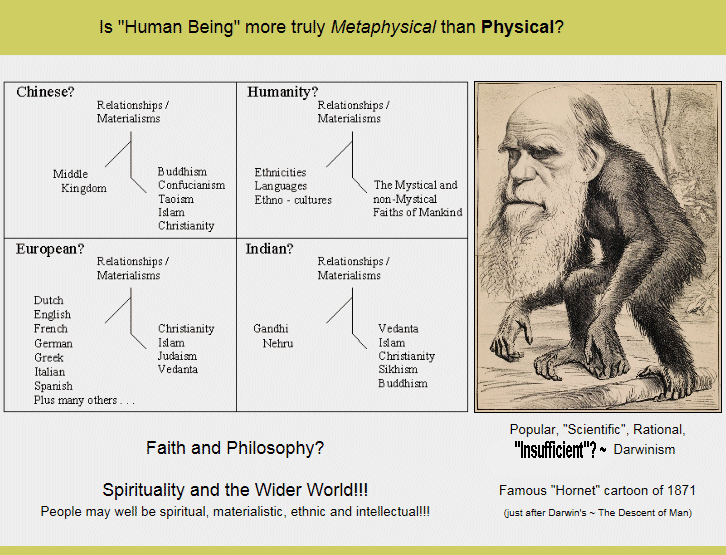
Whilst this present Age-of-the-Sage page content makes no attempt to address questions of whether the origins of Human Nature
are
~ "Natural? or Divine?" ~
our visitors can nevertheless find key insights on our site from such reliable authorities as:-
The Great Faiths - Plato & Socrates - Shakespeare
that give convincing support to such a "Tripartite" view of Human Nature!!!
~ "Natural? or Divine?" ~
our visitors can nevertheless find key insights on our site from such reliable authorities as:-
The Great Faiths - Plato & Socrates - Shakespeare
that give convincing support to such a "Tripartite" view of Human Nature!!!
It is widely known that Plato, pupil of and close friend to Socrates, accepted that Human Beings have a " Tripartite Soul " where the individual Human Psyche is noticeably composed of three aspects - Wisdom-Rationality, Spirited-Will and Appetite-Desire.
It is less widely appreciated is that Great World Faiths, and William Shakespeare, also effectively see "Spirituality" as being relative to "Desire" and to "Wrath".
On the basis that persons browsing the web cannot be expect to search out things that they do not readily appreciate "as being there to search for" we have assembled effective endorsements, from Plato & Socrates, World Faiths and Shakespeare, to a "Tripartism" of Wisdom-Rationality, Spirited-Will and Appetite-Desire on this link page:
The content of this page now turns to a rather detailed consideration of the history of the gradual development of what is thought of as Darwinian Evolutionary Theory.
Brief biographical information about Charles Darwin and Alfred Russel Wallace intended to convey how their respective backgrounds and characters gave them potential towards the development of the Theory of Evolution will be presented.
Mention is then made of such important influences as Thomas Malthus' Essay on Population followed by an outline description of the scientific interactions between Darwin and Wallace including several autobiographical quotes as well as some key excerpts from their letters.
Charles Darwin was born on February 12th 1809 at Shrewsbury, Shropshire, England. He was the fifth child of an highly reputable doctor named Robert Waring Darwin and his wife Susannah; and was a grandson of the physician, scientist, poet and indeed, polymath, Erasmus Darwin, (and, on his mother's side, of the pottery magnate Josiah Wedgwood).
He was taught in accordance with a Greek language based classics curriculum at Shrewsbury from 1818-1825. Although he had not proved to have much academic aptitude at school in Shrewsbury he then went to Edinburgh to study medicine but did not make worthwhile progress - partly because he did not relish the suffering of patients or the sight of blood resulting from medical procedures. In his autobiography he mentions that;-
"soon after this period I became convinced from various small circumstances that my Father would leave me property enough to subsist on with some comfort ... my belief was sufficient to check any strenuous effort to learn medicine".
Another attempt at securing a gentleman's education and career was made, after his father had suggested the Church, by sending him to Christ's College, Cambridge, in 1827, to study theology with a view to becoming ordained as a clergyman.
During his Cambridge years he did not immerse himself in Theological studies but rather fell in with a set who were keen on fox-hunting and game shooting. He also loved to collect plants, insects, and geological specimens, guided by his cousin William Darwin Fox, an entomologist. He developed a particular interest in collecting beetles, the rarer in species the better. His autobiography quotes one particular beetle hunt in detail:-
"I will give a proof of my zeal: one day on tearing off some old bark, I saw two rare beetles and seized one in each hand; then I saw a third and new kind, which I could not bear to lose, so that I popped the one which I held in my right hand into my mouth. Alas it ejected some intensely acrid fluid, which burnt my tongue so that I was forced to spit the beetle out, which was lost, as well as the third one".
His modest and untrained scientific inclinations were encouraged by Adam Sedgewick, a geologist and also by a botany professor, John Stevens Henslow, who was instrumental, despite heavy paternal opposition, in securing a unpaid place for Darwin as a naturalist on a long term scientific expedition that was to be made by HMS Beagle under the command of Captain FitzRoy. In fact he only won parental consent to his joining the HMS Beagle after his uncle, Josiah Wedg(wood II, spoke on his behalf.
Charles Darwin, as an enthusiatic student of Natural History, took up the role of unpaid naturalist on what he was advised was to be a two-year voyage to distant seas and continents.
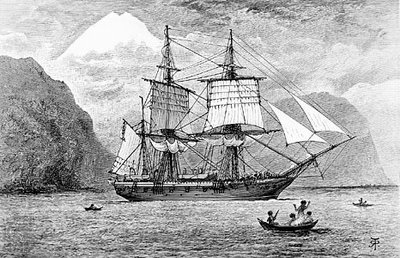
A crucial influence on his outlook on this trip arose out of his being given, by Captain FitzRoy, the first volume of Charles Lyell's book, Principles of Geology - with the subtitle of "An attempt to explain the former changes of the Earth's surface by reference to causes now in operation."
The perceived wisdom of the day had accepted that the Earth was only several thousand years old and dated from the time of Creation by God. Lyell proposed that the Earth was, in fact, millions of years old - allowing naturally arising processes time to gradually shape the Earth over immense time spans.
Darwin read this volume, which accepted the principle of extremely slow geological change, and presented a classic explanation of geological developments taking place over millions of years, during the initial phases of the voyage of the Beagle, which departed on its circumnavigation in November 1831. The second volume, which contained extensive discussion of the geographical distribution of species, ancient and modern, including speculations on their transmutation, caught up with him in Montevideo in October 1832.
These content of the first volume, in particular, resonated with the geological tour that Darwin had made with Adam Sedgwick, Professor of Geology at Cambridge, shortly before the departure of the Beagle. As a result, during the voyage Darwin largely considered himself a geologist, specialising in rocks and fossils, collecting botanical and faunal specimens as a supplementary interest.
The powerful long-term influence of Charles Lyell's Principles of Geology is seen in Darwin's later admission to Leonard Horner, Lyell's father-in-law:-
"I always feel as if my books came
half out of Lyell's brains & that I never acknowledge this
sufficiently, nor do I know how I can, without saying so in so many words - for I have always thought that the great merit of the
Principles, was that it altered the whole tone of one's mind &
therefore that when seeing a thing never seen by Lyell, one yet saw it partially through his eyes."
When he began his voyage on the HMS Beagle Charles Darwin's intended career in the church had not
been explicitly abandoned - English society then accepted that clergymen could take a serious interest in God's Creation through studies
in Natural History.
Alfred Russel Wallace
Alfred Russel Wallace (1823-1913) was born near Usk, Monmouthshire (now part of Gwent), Wales as the eighth child of the family. His father was employed as librarian in Hertford, an English county town not too far distant from London. Unfortunately Mr. Wallace lost much of his remaining property through ill advised dealings in 1835 resulting in real hardship for the family - Alfred Russel Wallace, then barely into his teenage years, had to cut short his formal education late in 1836.
Family contacts in the form of an older brother, William, owning a surveying business led to Wallace embarking on a career as a surveyor where a growing interest in Natural History could also be followed up, to some extent, between daily tasks.
It happened, however, that William Wallace's business fell on hard times causing Wallace to lose his place in 1844. He was now successful in gaining a position as a teacher of Surveying in the Collegiate School in Leicester where he had access to a library where there were several reliable books on Natural History.
In 1844 Wallace made the acquaintance of another young man seriously interested in Natural History named Henry Walter Bates, who, although only nineteen years of age, was a well-recognised proficient in the then fashionable pursuit of beetle-collecting and who had already been able to get some scholarly work in Entomology printed in the learned journal, Zoologist.
Other formative developments in his life in these times included attendance at a demonstration of mesmerism - Wallace found that he could himself reproduce the same effects as the mesmerist demonstated and, more seriously, the death of his brother, William, in February 1845 which was followed by Wallace returning to surveying and his brother, John, joining him in the business. Wallace found his adminstrative responsibilities particularly arduous. After the failure of the business Wallace worked as a surveyor in connection with a proposed railway in the Vale of Neath. He also found time to give lectures on science and engineering at the Mechanics' Institute of Neath and to act as a curator of the Neath Philosophical and Literary Institute's museum.
His interest in Natural History continued and he entered into a regular correspondence with his friend Henry Bates. During thes times Wallace seems to have read, and to have corresponded with Henry Bates about, Charles Darwin's journal on the Voyage of the Beagle, Charles Lyell's Principles of Geology which offered to demonstrate how long-term change, in Geology in this instance, could be effected through the operation of slow, long-term processes, and an anonomously published work Vestiges of the Natural History of Creation, (later known to be by Robert Chambers), which was an early, popular, and notably controversial effort at arguing pursuasively against both Creationism and Lamarckism as full explanations of the existence of the solar system, the earth, and the diversity of species.
The latter two of these works might be thought to have almost prepared Alfred Russel Wallace's mind for an acceptance of evolutionism.
In a letter to Bates dated November 9th, 1845, he concludes by asking, "Have you read 'Vestiges of the Natural History of Creation,' or is it out of your line?" and in the next (dated December 28th), in reply to one from his friend, he continues, "I have a rather more favourable opinion of the 'Vestiges' than you appear to have, I do not consider it a hasty generalisation, but rather an ingenious hypothesis strongly supported by some striking facts and analogies, but which remains to be proved by more facts and the additional light which more research may throw upon the problem.... It furnishes a subject for every observer of nature to attend to; every fact," he observes, "will make either for or against it, and it thus serves both as an incitement to the collection of facts, and an object to which they can be applied when collected. Many eminent writers support the theory of the progressive development of animals and plants. There is a very philosophical work bearing directly on the question - Lawrence's 'Lectures on Man'.... The great object of these 'Lectures' is to illustrate the different races of mankind, and the manner in which they probably originated, and he arrives at the conclusion (as also does Prichard in his work on the 'Physical History of Man') that the varieties of the human race have not been produced by any external causes, but are due to the development of certain distinctive peculiarities in some individuals which have thereafter become propagated through an entire race. Now, I should say that a permanent peculiarity not produced by external causes is a characteristic of 'species' and not of mere 'variety,' and thus, if the theory of the 'Vestiges' is accepted, the Negro, the Red Indian, and the European are distinct species of the genus Homo.
"An animal which differs from another by some decided and permanent character, however slight, which difference is undiminished by propagation and unchanged by climate and external circumstances, is universally held to be a distinct species; while one which is not regularly transmitted so as to form a distinct race, but is occasionally reproduced from the parent stock (like albinoes), is generally, if the difference is not very considerable, classed as a variety. But I would class both these as distinct species, and I would only consider those to be varieties whose differences are produced by external causes, and which, therefore, are not propagated as distinct races."
Again, writing to Bates some months later, in 1847: "I begin to feel rather dissatisfied with a mere local collection; little is to be learnt by it. I should like to take some one family to study thoroughly, principally with a view to the theory of the origin of species. By that means I am strongly of opinion that some definite results might be arrived at." And he further alludes to "my favourite subject - the variations, arrangements, distribution, etc., of species."
Wallace had read Charles Darwin's book about the Voyage of the Beagle and his admiration for the adventures
and the observations of natural phenomena that Darwin wrote about as having occured during the Beagle voyage
and also those related in
a book by William H.
Edwards entitled
A Voyage Up the River Amazon which came into Wallace's hands resulted in his
suggesting to his friend Bates that they set themselves up as professional collectors of Natural History specimens
to supply the needs of institutions and gentlemen
naturalists. The two young men, they were both in their early twenties, sailed for the mouth of the Amazon in April, 1848.
In South America Wallace and Bates worked independently of each other with Wallace travelling and collecting
samples in the Amazon basin for several years until, early 1852, ill health led him to decide to return home to England.
"An animal which differs from another by some decided and permanent character, however slight, which difference is undiminished by propagation and unchanged by climate and external circumstances, is universally held to be a distinct species; while one which is not regularly transmitted so as to form a distinct race, but is occasionally reproduced from the parent stock (like albinoes), is generally, if the difference is not very considerable, classed as a variety. But I would class both these as distinct species, and I would only consider those to be varieties whose differences are produced by external causes, and which, therefore, are not propagated as distinct races."
Again, writing to Bates some months later, in 1847: "I begin to feel rather dissatisfied with a mere local collection; little is to be learnt by it. I should like to take some one family to study thoroughly, principally with a view to the theory of the origin of species. By that means I am strongly of opinion that some definite results might be arrived at." And he further alludes to "my favourite subject - the variations, arrangements, distribution, etc., of species."
His activities as a collector of Natural History specimens, and his authorship of academic papers and of his two books that were fairly well received brought him a little bit of notice in the then somewhat fashionable Natural History circles of society and, during these times he became introduced to many interested persons including one Charles Darwin.
Wallace is considered to have been something of a convinced evolutionist but without seeing how such evolution might be driven.
In September 1855 a paper entitled On the Law which has regulated the Introduction of New Species by ALFRED R. WALLACE, F.R.G.S. (i.e. Fellow of the Royal Geographical Society) appeared in a scientifically inclined publication Known as the Annals and Magazine of Natural History.
In this paper Wallace sets out his "Law" which he claims to have discovered some ten years previously and which he has since then been subject to testing. This possible Law being that:-
Every species has come into existence coincident both in space and time with a pre-existing closely allied species.
Shortly thereafter Wallace's paper continues:-
the order in which the several species came into existence, each one having had for its immediate antitype a closely related species existing at the time of its origin. It is evidently possible that two or three distinct species may have had a common antitype, and that each of these may again have become the antitypes from which other closely allied species were created.
This paper was read by Sir Charles Lyell who found its contents to suggest strongly that
Species were not fixed creations of God, but were in fact naturally mutable.
Darwin's work in this area had been on-going for a long time. He had returned from his five years of voyaging and observation on the HMS Beagle in 1836 with a newly critical attitude to Biblical explanations of Creation and much personal observation of nature and of the operation of natural forces to consider.
Although trained as a clergyman Charles Darwin, in accordance with his passionate interest in Natural History, had sent home papers of considerable scientific merit to his influential friends in England during the course of his voyaging in HMS Beagle.
Some of these influential friends had made Darwin's discoveries quite widely known of amongst scientific circles in England and, unknown to himself, Darwin was gaining a reputation, back home, as an notable contributor to knowledge about several scientific areas.
This reputation was sufficient for Darwin's wealthy father to be persuaded to give Charles Darwin an allowance such as to allow the freedom to attempt to establish himself as a gentleman naturalist.
Some milestones in this unexpected new path followed by Charles Darwin include:-
On the return of the Beagle (October 1836) Charles Lyell invited Darwin to dinner and from then on they were close friends.
At this dinner on 29 October Charles Lyell introduced Darwin to the up-and-coming anatomist Richard Owen.
On 17 February 1837, Lyell used his presidential address at the Geographical Society to present Owen's findings to date on Darwin's fossils, noting particularly the unexpected implication that extinct species were related to current species in the same locality.
At the same meeting Darwin was elected to the Council of the Society. He had already been invited by FitzRoy to contribute a Journal based on his field notes as the natural history section of the captain's account of the recent Beagle voyage.
When FitzRoy's account was published in May 1839, Darwin's Journal and Remarks was a great success. Later that year it was published on its own, becoming the bestseller today known as The Voyage of the Beagle.
When HMS Beagle had called at Cape Town, on the southern coasts of Africa in 1836 on the return leg of its famous voyage, Captain Robert FitzRoy and the young naturalist Charles Darwin visited the famous English scientist John Herschel, (who was engaged in astronomical survey work there), on 4 June of that year.
Herschel had as recently as February, 1836, written to Charles Lyell concerning Lyell's book Principles of Geology - published in 1830, which had set out the idea of the extremely gradual formation of landscapes through natural processes.
In this letter Herschel apologised to Lyell for not previously acknowledging Lyell's making a presentation, to himself, of a copy of this book:-
I am perfectly ashamed not to have long since acknowledged your present of the new edition of your Geology, a work which I now read for the third time, and every time with increased
interest, as it appears to me one of those productions which work a complete revolution in their subject, by altering entirely the point of view in which it must thenceforward be contemplated.
You have succeeded, too, in adding dignity to a subject already grand, by exposing to view the immense extent and complication of the problems it offers for solution, and by unveiling a
dim glimpse of a region of speculation connected with it, where it seems impossible to venture without experiencing some degree of that mysterious awe ..."
Herschel continued:-
"... Of course I allude to that mystery of mysteries, the replacement of extinct species by others. Many will doubtless think your speculation too bold, but it is as
well to face the difficulty at once ...
... the origination of fresh species, could it ever come under our cognizance, would be found to be a natural in contradistinction to a miraculous process - although we perceive no indications of any process actually in progress which is likely to issue in such a result."
Darwin had earlier been profoundly influenced by reading Herschel's Introduction to the Study of Natural Philosophy during his last year at Cambridge University.
... the origination of fresh species, could it ever come under our cognizance, would be found to be a natural in contradistinction to a miraculous process - although we perceive no indications of any process actually in progress which is likely to issue in such a result."
"During my last year at Cambridge, I read with care and profound interest Humboldt's Personal Narrative. This work, and Sir J. Herschel's Introduction to the Study of Natural Philosophy,
stirred up in me a burning zeal to add even the most humble contribution to the noble structure of Natural Science. No one or a dozen other books influenced me nearly so much as these two."
Back in England Herschel's letter to Lyell was widely discussed in scientific circles and even appeared in
an appendix to Charles Babbage's Ninth Bridgewater Treatise, published in 1837. An entry in Darwin's Notebook E dated 2 December 1838 reads
- "Babbage 2d Edit. p. 226 - Herschel calls the appearance of new species the mystery of mysteries, & has grand passage upon the problem.! Hurrah - 'intermediate causes' ".
In the opening lines of The Origin of Species, Darwin writes that his intent is "to throw some light on the origin of species - that mystery of mysteries, as it has been called by one of our greatest philosophers."
During the last few months of the voyage of the Beagle, Darwin spent most of his time tidying up his extensive scientific notes with the aid of Syms Covington.
The animal notes were finished by the time the Cocos Keeling Islands, (in the South Pacific), were reached in April 1836, and the bird notes at Ascension Island, (in the South Atlantic), in July 1836.
By far the most important were the bird notes, for they contained the expansion of the brief account, written in the Galapagos in September 1835 of the three species of Mocking Birds (Thenca) found in the islands, into Darwin's realisation that these birds might provide the first example of island endemism, (or distinct specific type island by island), and hence of evidence that new species had been created.
The key, September 1835, section of these Ornithological Notes - in which specimen reference numbers appear - reads:-
These birds are closely allied in appearance to the Thenca of Chile (2169) or Callandra of la Plata (1216). In their habits I cannot point out a single difference; - They are lively inquisitive, active run fast, frequent houses to pick the meat of the Tortoise, which is hung up, - sing tolerably well; are said to build a simple open nest. - are very tame, a character in common with the other birds: I imagined however its note or cry was rather different from the Thenca of Chile? - Are very abundant, over the whole Island; are chiefly tempted up into the high & damp parts, by the houses & cleared ground.
I have specimens from four of the larger Islands; the two above enumerated, and (3349: female. Albermarle Isd.) & (3350: male: James Isd). - The specimens from Chatham & Albermarle Isd appear to be the same; but the other two are different. In each Isld. each kind is exclusively found: habits of all are indistinguishable. When I recollect, the fact that the form of the body, shape of scales & general size, the Spaniards can at once pronounce, from which Island any Tortoise may have been brought. When I see these Islands in sight of each other, & [the word "but" deleted here] possessed of but a scanty stock of animals, tenanted by these birds, but slightly differing in structure & filling the same place in Nature, I must suspect they are only varieties.
The only fact of a similar kind of which I am aware, is the constant asserted difference - between the wolf-like Fox of East & West Falkland Islds.
- If there is the slightest foundation for these remarks the zoology of Archipelagoes - will be well worth examining; for such facts [the word would inserted here] undermine the stability of Species.
As early as July 1837 Darwin opened a notebook to record his thoughts as this entry from his personal 'Journal',
which he kept between 1809-1881, relates:-
I have specimens from four of the larger Islands; the two above enumerated, and (3349: female. Albermarle Isd.) & (3350: male: James Isd). - The specimens from Chatham & Albermarle Isd appear to be the same; but the other two are different. In each Isld. each kind is exclusively found: habits of all are indistinguishable. When I recollect, the fact that the form of the body, shape of scales & general size, the Spaniards can at once pronounce, from which Island any Tortoise may have been brought. When I see these Islands in sight of each other, & [the word "but" deleted here] possessed of but a scanty stock of animals, tenanted by these birds, but slightly differing in structure & filling the same place in Nature, I must suspect they are only varieties.
The only fact of a similar kind of which I am aware, is the constant asserted difference - between the wolf-like Fox of East & West Falkland Islds.
- If there is the slightest foundation for these remarks the zoology of Archipelagoes - will be well worth examining; for such facts [the word would inserted here] undermine the stability of Species.
'In July opened first note Book on "transmutation of Species". - Had been greatly struck from about month of previous March on character of S. American fossils - & species on
Galapagos Archipelago. - These facts origin (especially latter) of all my views.'
The direction of Darwin's thoughts can perhaps be illustrated by this famous sketch:-
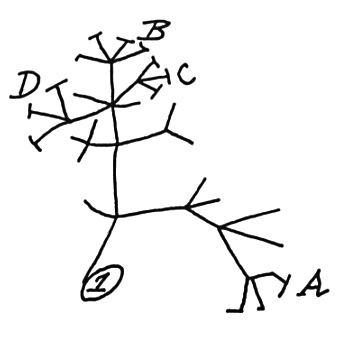
Charles Darwin's Tree of Life sketch from his Notebook B dating from 1837-8, (and deemed by editors of Darwin's papers to be concerned with his thoughts about the Transmutation of Species), shows his early theoretical insight of how a genus of related species might originate by divergence from a starting point (1).
An accompanying text annotation reads:-
I think
Case must be that one generation then should be as many living as now. To do this & to have many species in same genus (as is) requires extinction.
Thus between A & B immense gap of relation. C & B the finest gradation, B & D rather greater distinction. Thus genera would be formed. - bearing relation (page 36 ends - page 37 begins) to ancient types with several extinct forms.
From Darwin's notebook B now stored in Cambridge University library
ALSO FROM NOTEBOOK B OF 1837!!!
The above "Tree of Life sketch" appears on page 36 of the notebook - the first 35 pages being effectively taken up by Darwin's consideration of his grandfather Erasmus Darwin's earlier evolutionary musings as published in Zoonomia; or the Laws of Organic Life (1794) a two-volume medical work dealing with pathology, anatomy, psychology, and the functioning of the body.Charles Darwin had first read his grandfather's work at the age of eighteen and may have returned to it in 1837 as a possible source of inspiration in relation to his own theorising. The title Zoonomia actually appears as the heading of page 1 of Darwin's Notebook B of 1837.
Erasmus Darwin's work includes the following acceptance of heritable evolutionary change:-
On the other hand
swiftness of wing has been acquired by hawks and swallows to pursue their prey;
and a proboscis of admirable structure has been acquired by the bee, the moth,
and the humming bird, for the purpose of plundering the nectaries of flowers.
All which seem to have been formed by the original living filament, excited into
action by the necessities of the creatures, which possess them, and on which
their existence depends.
From thus meditating on the great similarity of the structure of the warm-blooded animals, and at the same time of the great changes they undergo both before and after their nativity; and by considering in how minute a portion of time many of the changes of animals above described have been produced; would it be too bold to imagine, that in the great length of time, since the earth began to exist, perhaps millions of ages before the commencement of the history of mankind, would it be too bold to imagine, that all warm-blooded animals have arisen from one living filament, which THE GREAT FIRST CAUSE endued with animality, with the power of acquiring new parts, attended with new propensities, directed by irritations, sensations, volitions, and associations; and thus possessing the faculty of continuing to improve by its own inherent activity, and of delivering down those improvements by generation to its posterity, world without end!
Erasmus Darwin's idea of heritable evolutionary change being that a potentially rapid one driven by the "necessities of the creatures"
where new parts and new propensities were open to being acquired - after birth - in line with such necessities in accordance
with an unexplained "power of acquiring new parts".:-
From thus meditating on the great similarity of the structure of the warm-blooded animals, and at the same time of the great changes they undergo both before and after their nativity; and by considering in how minute a portion of time many of the changes of animals above described have been produced; would it be too bold to imagine, that in the great length of time, since the earth began to exist, perhaps millions of ages before the commencement of the history of mankind, would it be too bold to imagine, that all warm-blooded animals have arisen from one living filament, which THE GREAT FIRST CAUSE endued with animality, with the power of acquiring new parts, attended with new propensities, directed by irritations, sensations, volitions, and associations; and thus possessing the faculty of continuing to improve by its own inherent activity, and of delivering down those improvements by generation to its posterity, world without end!
Charles Darwin's I Think diagram on page 36 may then represent his own claim to distinct theorising.
It seems that in these early times Darwin felt himself to be actually on the cusp of developing a most far-reaching theory.
If we peruse another Notebook B page, also dating from 1837, it can be appreciated how much of the foundation for his eventual Origin of Species theory was already being "mentally" laid out all of 22 years before the eventual publication of the Origin of Species.:-
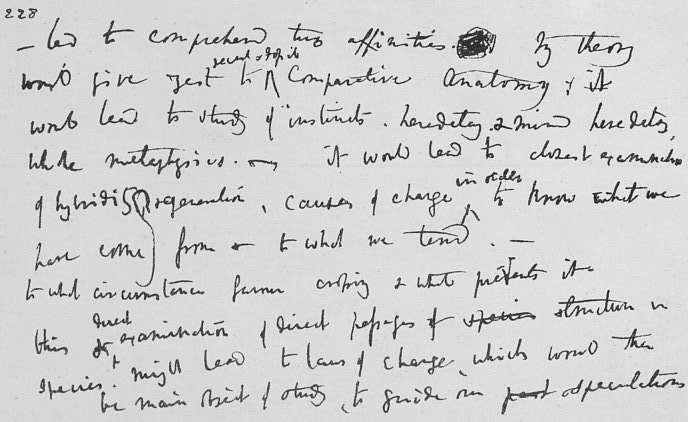
The text reads:-
...led to comprehend true affinities. My theory would give zest to recent & Fossil Comparative Anatomy: it would lead to study of instincts, heredity, & mind heredity, whole metaphysics, it would lead to closest examination of hybridity & generation, causes of change in order to know what we have come from & to what we tend, to what circumstances favour crossing & what prevents it, this and direct examination of direct passages of structure in species, might lead to laws of change, which would then be main object of study, to guide our speculations...
Page 228 ends page 229 begins:-
...with respect to past & future. The Grand Question, which every naturalist ought to have before him, when dissecting a whale, or classifying a mite, a fungus, or an infusorian. is "What are the laws of life".-
Late in life Charles Darwin was approached by a German publisher who was keen to publish Darwin's life story including a coverage of the development of his ideas.
In this autobiography Darwin wrote:-
"I had been deeply impressed by discovering in the Pampean formation
great fossil animals covered with armour like
that on the existing armadillos; secondly by the manner in which closely allied animals replace one another in proceeding southwards over the Continent; and thirdly, by the
South American character of most of the productions of the Galapagos archpelago, and more especially by the manner in which they differ on each island of the group; none of the islands
appearing to be very ancient in a geological sense."
Darwin further wrote;- "It was evident that such facts as these, as well as many others, could only be explained on the supposition that species gradually became modified; and the subject haunted me. But it was equally evident that neither the action of surrounding conditions, nor the will of the organisms (especially in the case of plants) could account for the innumerable cases in which organisms of every kinds are beautifully adapted to their habits of life ..."
Darwin further wrote;- "It was evident that such facts as these, as well as many others, could only be explained on the supposition that species gradually became modified; and the subject haunted me. But it was equally evident that neither the action of surrounding conditions, nor the will of the organisms (especially in the case of plants) could account for the innumerable cases in which organisms of every kinds are beautifully adapted to their habits of life ..."
It seems that Darwin felt that he could not publish his acceptance of transmutation unless he could explain it:-
"I had always been struck by such adaptations, and until these could be explained it seemed to me almost useless to endeavour to prove by direct evidence that species have been modified ..."
A later section of this autobiography relates a key stage in his development of an inherently persuasive hypothesis about a scenario where there would be a naturally explicable origin of species being his reading, late in 1838, of an Essay by the Reverend Thomas Malthus.
To use Charles Darwin's own words from his Autobiography:-
"..After my return to England it appeared to me that by following the example of Lyell in Geology, and by collecting all facts which bore in any way on the variation of animals and plants under
domestication and nature, some light might perhaps be thrown on the whole subject. My first note-book was opened in July 1837. I worked on true Baconian principles, and without any theory
collected facts on a wholesale scale, more especially with respect to domesticated productions, by printed enquiries, by conversation with skilful breeders and gardeners, and by extensive reading.
When I see the list of books of all kinds which I read and abstracted, including whole series of Journals and Transactions, I am surprised at my industry. I soon perceived that selection was the
keystone of man's success in making useful races of animals and plants. But how selection could be applied to organisms
living in a state of nature remained for some time a mystery to me.
Fifteen months after I had begun my systematic enquiry, I happened to read for amusement Malthus on Population, and being well prepared to appreciate the struggle for existence which everywhere goes on from long-continued observation of the habits of animals and plants, it at once struck me that under these circumstances favourable variations would tend to be preserved, and unfavourable ones to be destroyed. The result of this would be the formation of a new species.
Here, then, I had at last got a theory by which to work; but I was so anxious to avoid prejudice, that I determined not for some time to write even the briefest sketch of it."
And why was Charles Darwin so excited?
Fifteen months after I had begun my systematic enquiry, I happened to read for amusement Malthus on Population, and being well prepared to appreciate the struggle for existence which everywhere goes on from long-continued observation of the habits of animals and plants, it at once struck me that under these circumstances favourable variations would tend to be preserved, and unfavourable ones to be destroyed. The result of this would be the formation of a new species.
Here, then, I had at last got a theory by which to work; but I was so anxious to avoid prejudice, that I determined not for some time to write even the briefest sketch of it."
In his Essay on the Principle of Population
Thomas Malthus had suggested that:-
"... Through the animal and vegetable kingdoms nature has scattered the seeds of life abroad with the most profuse and liberal hand. She has been comparatively sparing in the room and the nourishment necessary to rear them. The germs of existence contained in this spot of earth, with ample food, and ample room to expand in, would fill millions of worlds in a few thousand years. Necessity, that imperious and all-pervading law of nature, restrains them within the prescribed bounds. The race of plants and the race of animals shrink under this great restrictive law ..."
Darwin took up Malthus' "imperious and all-pervading law of nature" as providing a mechanism whereby individuals within a species which,
because of some very slight variation, were better suited in win out in the "struggle for survival" by being more able to gain the food necessary
to allow them to survive in the short term,
and to allow them to become the parents of a new generation - which could thereby tend inherit this favourable very slight variation -
in the longer term."... Through the animal and vegetable kingdoms nature has scattered the seeds of life abroad with the most profuse and liberal hand. She has been comparatively sparing in the room and the nourishment necessary to rear them. The germs of existence contained in this spot of earth, with ample food, and ample room to expand in, would fill millions of worlds in a few thousand years. Necessity, that imperious and all-pervading law of nature, restrains them within the prescribed bounds. The race of plants and the race of animals shrink under this great restrictive law ..."
(This basic and food-related struggle for survival between individuals within an existing species proved to be capable of extension towards a consideration of a more complex and food-related struggle for survival between existing species and new species).
Darwin continued to develop a theory expaining the naturally arising development of new species but at the same time had begun to think seriously that life as a scholarly bachelor would be unappealing and decided to attempt to pay court to his sincerely religious first cousin, Emma Wedgwood. By the summer of 1838 Emma agreed to marry Charles Darwin, knowing him to hold skeptical views and even wrote to him soon after their engagement telling him that she was sad that "our opinions on the most important subject should differ widely."
As wife to Charles Darwin Emma continued to hold strong religious beliefs and to be distressed by the absence of God in her husband's theorising always quietly encouraging him to see faith as a matter for "feeling, not reasoning".
Emma Darwin was in the habit of actually writing letters to her husband! She thought that by so doing she could better compose her intimate thoughts for his consideration. One such letter includes the following passage;-
May not the habit in scientific pursuits of believing nothing till it is proved, influence your mind too much in other things which
cannot be proved in the same way, and which if true are likely to be above our comprehension ...
Darwin had grown up in and, despite his own skepticism after returning from his voyages, continued to live in a society that generally accepted biblical
explanations of creation whereby the Earth and all of its unchanging, immutable, life forms were, as they were and
as they ever had been, as a result of Original Acts of Divine Creation.
Against this pervasive cultural background, in a confidential letter of 11 January 1844 to a fellow scientist named Joseph Hooker, Darwin wrote about how his views had developed since his return from his voyaging on the Beagle:-
I have been now ever since my return engaged in a very presumptuous work & which I know no one individual who wd not say a very
foolish one.- I was so struck with distribution of Galapagos organisms &c &c & with the character of the American fossil mammifers,
&c &c that I determined to collect blindly every sort of fact, which cd bear any way on what are species.- I have read heaps of agricultural
& horticultural books, & have never ceased collecting facts- At last gleams of light have come, & I am almost convinced (quite contrary to
opinion I started with) that species are not (it is like confessing a murder) immutable. Heaven forfend me from Lamarck nonsense of a
"tendency to progression" "adaptations from the slow willing of animals" &c, - but the conclusions I am led to are not widely different
from his - though the means of change are wholly so - I think I have found out (here's presumption!) the simple way by which species
become exquisitely adapted to various ends.- You will now groan, & think to yourself 'on what a man have I been wasting my
time in writing to.'- I shd, five years ago, have thought so.-
During 1844, Darwin, with Emma's editorial advice and participation, extended an initial thirty-five page
abstract of his theory
written in pencil in 1842 by preparing a two hundred and thirty page-long overview
of his theory for publication. He also framed, in July 1844, an accompanying letter to his
wife urging as to how she was to seek the aid of friends to that end and asking her to regard a then substantial sum
as being set aside to fund the project:-
I have just finished my sketch of my species theory. If as I believe that my theory is true & if it be accepted even by one competent judge, it will be
a considerable step in science. I therefore write this, in case of my sudden death, as my most solemn & last request, which I am sure you will
consider the same as if legally entered in my will, that you will devote 400£ to its publication & further will yourself, or through
Hensleigh [Wedgwood], take trouble in promoting it.
It should not be over-looked that although Darwin was then only some thirty-five years old he had had many bouts of serious illness
since returning home from his Beagle voyage. It is thought he may have picked up an intermittently seriously debilitating condition
known as Chagas Fever during those years of travel and exploration in far-flung places.
Both the pencil sketch of 1842 and the fleshed-out Essay of 1844 are included in Darwin, Francis ed. 1909. The foundations of The origin of species. Two essays written in 1842 and 1844. Cambridge: Cambridge University Press.
Francis Darwin says of the pencil sketch of 1842:-
The sketch of 1842 is written on bad paper with a soft pencil, and is in many parts extremely difficult to read, many of the words ending in mere scrawls and being illegible without context. It is evidently written rapidly, and is in his most elliptical style, the articles being frequently omitted, and the sentences being loosely composed and often illogical in structure. There is much erasure and correction, apparently made at the moment of writing, and the MS. does not give the impression of having been re-read with any care. The whole is more like hasty memoranda of what was clear to himself, than material for the convincing of others.
The pencil sketch of 1842 is recorded, by Francis Darwin, as being open to being laid under
a series of sectional headings.
The sections into which the Essay of 1842 is divided are in the original merely indicated by a gap in the MS. or by a line drawn across the page. No titles are given except
in the case of § VIII.; and § II. is the only section which has a number in the original. I might equally well have made sections of what are now subsections, e.g. Natural
Selection p. 7, or Extermination p. 28. But since the present sketch is the germ of the Essay of 1844, it seemed best to preserve the identity between the two works, by
using such of the author's divisions as correspond to the chapters of the enlarged version of 1844. The geological discussion with which Part II begins corresponds to two
chapters (IV and V) of the 1844 Essay. I have therefore described it as §§ IV. and V., although I cannot make sure of its having originally consisted of two sections.
With this exception the ten sections of the Essay of 1842 correspond to the ten chapters of that of 1844.
Francis Darwin then lays out the pencil sketch of 1842 thusly:-
CONTENTS
ESSAY OF 1842
PART I
ESSAY OF 1842
PART I
§ i. On variation under domestication, and on the principles of selection ........ 1
§ ii. On variation in a state of nature and on the natural means of selection ....... 4
§ iii. On variation in instincts and other mental attributes . 17
PART II
§§ iv. and v. On the evidence from Geology.
(The reasons for combining the two sections are given in the Introduction) ......... 22
§ vi. Geographical distribution ...... 29
§ vii. Affinities and classification ...... 35
§ viii. Unity of type in the great classes .... 38
§ ix. Abortive organs ........ 45
§ x. Recapitulation and conclusion ..... 48
The next section features some comparisons between the sketch of 1844 with Darwin's eventual magnus opus.
The table of contents relating to how Charles Darwin's Origin of Species of 1859 was arranged into several chapters is set out in the following section to allow a greater depth of appreciation of the subject matters involved:-
CONTENTS.
~~~~~~~~~~~~~
Introduction
- CHAPTER I.
Variation under Domestication. -
Causes of Variability ~ Effects of Habit ~ Correlation of Growth ~ Inheritance ~ Character of Domestic Varieties ~ Difficulty of distinguishing between Varieties and Species ~ Origin of Domestic Varieties from one or more Species ~ Domestic Pigeons, their Differences and Origin ~ Principle of Selection anciently followed, its Effects ~ Methodical and Unconscious Selection ~ Unknown Origin of our Domestic Productions ~ Circumstances favourable to Man's power of Selection
Pages 7-43 - CHAPTER II.
Variation under Nature. -
Variability ~ Individual Differences ~ Doubtful species ~ Wide ranging, much diffused, and common species vary most ~ Species of the larger genera in any country vary more than the species of the smaller genera ~ Many of the species of the larger genera resemble varieties in being very closely, but unequally, related to each other, and in having restricted ranges
Pages 44-59 - CHAPTER III.
Struggle for Existence. -
Bears on natural selection ~ The term used in a wide sense ~ Geometrical powers of increase ~ Rapid increase of naturalised animals and plants ~ Nature of the checks to increase ~ Competition universal ~ Effects of climate ~ Protection from the number of individuals ~ Complex relations of all animals and plants throughout nature ~ Struggle for life most severe between individuals and varieties of the same species; often severe between species of the same genus ~ The relation of organism to organism the most important of all relations
Pages 60-79 - CHAPTER IV.
Natural Selection. -
Natural Selection ~ its power compared with man's selection ~ its power on characters of trifling importance ~ its power at all ages and on both sexes ~ Sexual Selection ~ On the generality of intercrosses between individuals of the same species ~ Circumstances favourable and unfavourable to Natural Selection, namely, intercrossing, isolation, number of individuals ~ Slow action ~ Extinction caused by Natural Selection ~ Divergence of Character, related to the diversity of inhabitants of any small area, and to naturalisation ~ Action of Natural Selection, through Divergence of Character and Extinction, on the descendants from a common parent ~ Explains the Grouping of all organic beings
Pages 80-130 - CHAPTER V.
Laws of Variation. -
Effects of external conditions ~ Use and disuse, combined with natural selection; organs of flight and of vision ~ Acclimatisation ~ Correlation of growth ~ Compensation and economy of growth ~ False correlations ~ Multiple, rudimentary, and lowly organised structures variable ~ Parts developed in an unusual manner are highly variable: specific characters more variable than generic: secondary sexual characters variable ~ Species of the same genus vary in an analogous manner ~ Reversions to long-lost characters ~ Summary
Pages 131-170 - CHAPTER VI.
Difficulties on Theory. -
Difficulties on the theory of descent with modification ~ Transitions ~ Absence or rarity of transitional varieties ~ Transitions in habits of life ~ Diversified habits in the same species ~ Species with habits widely different from those of their allies ~ Organs of extreme perfection ~ Means of transition ~ Cases of difficulty ~ Natura non facit saltum ~ Organs of small importance ~ Organs not in all cases absolutely perfect ~ The law of Unity of Type and of the Conditions of Existence embraced by the theory of Natural Selection
Pages 171-206 - CHAPTER VII.
Instinct. -
Instincts comparable with habits, but different in their origin ~ Instincts graduated ~ Aphides and ants ~ Instincts variable ~ Domestic instincts, their origin ~ Natural instincts of the cuckoo, ostrich, and parasitic bees ~ Slave-making ants ~ Hive-bee, its cell-making instinct ~ Difficulties on the theory of the Natural Selection of instincts ~ Neuter or sterile insects ~ Summary
Pages 207-244 - CHAPTER VIII.
Hybridism. -
Distinction between the sterility of first crosses and of hybrids ~ Sterility various in degree, not universal, affected by close interbreeding, removed by domestication ~ Laws governing the sterility of hybrids ~ Sterility not a special endowment, but incidental on other differences ~ Causes of the sterility of first crosses and of hybrids ~ Parallelism between the effects of changed conditions of life and crossing ~ Fertility of varieties when crossed and of their mongrel offspring not universal ~ Hybrids and mongrels compared independently of their fertility ~ Summary
Pages 245-278 - CHAPTER IX.
On the Imperfection of the Geological Record. -
On the absence of intermediate varieties at the present day ~ On the nature of extinct intermediate varieties; on their number ~ On the vast lapse of time, as inferred from the rate of deposition and of denudation ~ On the poorness of our palaeontological collections ~ On the intermittence of geological formations ~ On the absence of intermediate varieties in any one formation ~ On the sudden appearance of groups of species ~ On their sudden appearance in the lowest known fossiliferous strata
Pages 279-311 - CHAPTER X.
On the Geological Succession of Biological Beings. -
On the slow and successive appearance of new species ~ On their different rates of change ~ Species once lost do not reappear ~ Groups of species follow the same general rules in their appearance and disappearance as do single species ~ On Extinction ~ On simultaneous changes in the forms of life throughout the world ~ On the affinities of extinct species to each other and to living species ~ On the state of development of ancient forms ~ On the succession of the same types within the same areas ~ Summary of preceding and present chapters
Pages 312-345 - CHAPTER XI.
Geographical Distribution. -
Present distribution cannot be accounted for by differences in physical conditions ~ Importance of barriers ~ Affinity of the productions of the same continent ~ Centres of creation ~ Means of dispersal, by changes of climate and of the level of the land, and by occasional means ~ Dispersal during the Glacial period co-extensive with the world
Pages 346-382 - CHAPTER XII.
Geographical Distribution - continued -
Distribution of fresh-water productions ~ On the inhabitants of oceanic islands ~ Absence of Batrachians and of terrestrial Mammals ~ On the relation of the inhabitants of islands to those of the nearest mainland ~ On colonisation from the nearest source with subsequent modification ~ Summary of the last and present chapters
Pages 383-410 - CHAPTER XIII.
Mutual Affinities of Organic Beings: Morphology:
Embryology: Rudimentary Organs. -
Classification, groups subordinate to groups ~ Natural system ~ Rules and difficulties in classification, explained on the theory of descent with modification ~ Classification of varieties ~ Descent always used in classification ~ Analogical or adaptive characters ~ Affinities, general, complex and radiating ~ Extinction separates and defines groups ~ Morphology, between members of the same class, between parts of the same individual ~ Embryology, laws of, explained by variations not supervening at an early age, and being inherited at a corresponding age ~ Rudimentary Organs; their origin explained ~ Summary
Pages 411-458 - CHAPTER XIV.
Recapitulation and Conclusion. -
Recapitulation of the difficulties on the theory of Natural Selection ~ Recapitulation of the general and special circumstances in its favour ~ Causes of the general belief in the immutability of species ~ How far the theory of natural selection may be extended ~ Effects of its adoption on the study of Natural history ~ Concluding remarks
Pages 459-490 - Index
-
This sketch of 1844 receives the following mention in Darwin, Francis ed. 1887. The life and letters of Charles Darwin, including an autobiographical chapter. London: John Murray. Volume 2.
The sketch of 1844 is written in a clerk's hand, in two hundred and thirty-one pages folio, blank leaves being alternated with the MS. with a view to amplification.
The text has been revised and corrected, criticisms being pencilled by himself on the margin. It is divided into two parts: I. "On the variation of Organic Beings under Domestication and
in their Natural State." II. "On the Evidence favourable and opposed to the view that Species are naturally formed races descended from common Stocks." The first part contains
the main argument of the 'Origin of Species.' It is founded, as is the argument of that work, on the study of domestic animals, and both the Sketch and the 'Origin' open with a chapter
on variation under domestication and on artificial selection. This is followed, in both essays, by discussions on variation under nature, on natural selection, and on the struggle for life. Here,
any close resemblance between the two essays with regard to arrangement ceases. Chapter III. of the Sketch, which concludes the first part, treats of the variations which occur in the
instincts and habits of animals, and thus corresponds to some extent with Chapter VII. of the 'Origin' (1st edit.). It thus forms a complement to the chapters which deal with variation in
structure. It seems to have been placed thus early in the Essay to prevent the hasty rejection of the whole theory by a reader to whom the idea of natural selection acting on instincts might
seem impossible. This is the more probable, as the Chapter on Instinct in the 'Origin' is specially mentioned (Introduction, p. 5) as one of the "most apparent and gravest difficulties on the
theory." Moreover the chapter in the Sketch ends with a discussion, "whether any particular corporeal structures ... are so wonderful as to justify the rejection prima facie of our theory."
Under this heading comes the discussion of the eye, which in the 'Origin' finds its place in Chapter VI. under "Difficulties on Theory." ...
Late in 1844 a work entitled "Vestiges of the Natural History of Creation" was published anonymously in London. This book proposed a theory of Transmutation whereby everything then existing, from the solar system to the Earth and its animal and vegetable life-forms, had an origin explicable in terms of development from earlier forms.
"Vestiges" argued in relation to the increasingly available fossil evidence about formerly living, but now extinct mammals:-
many forms are altogether gone, while of others we have now only kindred species. Thus to find not only frequent additions to the previous existing forms,
but frequent withdrawals of forms which had apparently become inappropriate - a constant shifting as well as advance - is a fact calculated very
forcibly to arrest attention. A candid consideration of all these circumstances can scarcely fail to introduce into our minds a somewhat different idea
of organic creation from what has hitherto been generally entertained. (page 152)
To a reasonable mind the Divine attributes must appear, not diminished or reduced in some way, by supposing a creation by law, but infinitely exalted. It is the narrowest of all views of the Deity, and characteristic of a humble class of intellects, to suppose him acting constantly in particular ways for particular occasions. It, for one thing, greatly detracts from his foresight, the most undeniable of all the attributes of Omnipotence. It lowers him towards the level of our own humble intellects. Much more worthy of him it surely is, to suppose that all things have been commissioned by him from the first, though neither is he absent from a particle of the current of natural affairs in one sense, seeing that the whole system is continually supported by his providence (pp.156-157).
The "Vestiges of the Natural History of Creation" seemed to offer an explanation of things hitherto inexplicable but
from several points of view gave cause of outrage to traditional religious opinion.To a reasonable mind the Divine attributes must appear, not diminished or reduced in some way, by supposing a creation by law, but infinitely exalted. It is the narrowest of all views of the Deity, and characteristic of a humble class of intellects, to suppose him acting constantly in particular ways for particular occasions. It, for one thing, greatly detracts from his foresight, the most undeniable of all the attributes of Omnipotence. It lowers him towards the level of our own humble intellects. Much more worthy of him it surely is, to suppose that all things have been commissioned by him from the first, though neither is he absent from a particle of the current of natural affairs in one sense, seeing that the whole system is continually supported by his providence (pp.156-157).
Darwin's friend and mentor, Reverend Adam Sedgwick, subsequently wrote an unstinting 85-page critique, of the highly controversial anonymous work that was published in the July, 1845, edition of the then widely influential Edinburgh Review,
... Vestiges "comes before [its readers] with a bright, polished, and many-coloured surface, and the serpent coils a false philosophy, and asks them to stretch out their hands and pluck the forbidden fruit,"
In October 1845 Charles Darwin wrote to his friend Sir Charles Lyell and made some mention of Sedgwick's Review
of Vestiges:-
...I have been much interested with Sedgwick Review; though I find it is far from popular with non-scientific readers. I think some few passages savour of the
dogmatism of the pulpit, rather than of the philosphy of the Professor chair; & some of the wit strikes me as only worthy of Broderip in the Quarterly.
Nevertheless it a grand piece of argument against mutability of species; & I read it with fear & trembling, but was well pleased to find, that I had not
overlooked any of the arguments, though I had put them to myself as feebly as milk & water.
Even though he went to the trouble of gathering his thoughts so as to prepare a manuscript overview of his
theorising, Darwin actually preferred to keep his potentially most controversial
ideas a private matter because of
his reluctance to meet an expected adverse reaction from family, friends, and the wider public by airing controversial views. He
may have been particularly reluctant to cause distress to Emma, his sincerely christian wife.Despite the time and effort put into its preparation the manuscript overview was placed in storage in a securely sealed packet that bore the message "Only to be opened in the event of my death" written by Darwin's own hand.
Darwin placed this sealed and solemnly directed parcel in a cupboard under the stairs of his home in Kent! It was to remain there for some fifteen years!
During these times Darwin continued to live in the Kent countryside and, when his health allowed, to thoroughly investigate how species might change through converstions with pidgeon fanciers and farmers as well as conducting a large number of scientific experiments. He kept up friendships with a wide range of persons and communicated widely by letter with other parties interested in Natural History.
One such friendship was with Sir Charles Lyell and one particular debating point between them was whether or not individual species were fixed in form or whether their forms were open to change.
As has already been mentioned in September 1855 a paper entitled On the Law which has regulated the Introduction of New Species by ALFRED R. WALLACE, F.R.G.S. appeared in a scientifically inclined publication known as the Annals and Magazine of Natural History.
This paper was read by the famous geologist Sir Charles Lyell, a famous geologist and a personal friend of long-standing to Charles Darwin. Lyell, against his own previous and strongly held opinions, found its contents to suggest strongly that species were not fixed creations of God, but were, in fact, naturally mutable. In November 1855, soon after reading Wallace's article, Lyell seems to have started keeping a "species notebook" in which to record his own thoughts about a possible mutability in species.
Between 13-16 April 1856 Sir Charles Lyell and his wife paid a visit to the Darwins, at their home in the Kentish countryside. Lyell made an entry in his diary on the 16 April headed 'With Darwin: On the Formation of Species by Natural Selection', and cited, among other things, the example of pigeons.
It appears that on this visit Darwin actually gave an outline of his theory of evolution by natural selection to Lyell - who urged Darwin to prepare some account of his theory for publication on the grounds that Wallace might seem to be the originator of these views if his species variation work, as outlined in his On the Law which has regulated the Introduction of New Species by ALFRED R. WALLACE, F.R.G.S., was the first to gain acceptance in scientific circles.
At this time Darwin was just after completing a major scientific work on the classification of living and fossil barnacles - a task that had taken up eight years of his life between 1846-1854, which had enhanced his scientific reputation, and which had given him deeper insights into species adaptation.
Sir Charles Lyell subsequently heard word about a week-end visit paid to the Darwin's during the last week of April by Joseph Dalton Hooker, Thomas Henry Huxley, and Thomas Vernon Wollaston, possibly from his scientific friends Hooker and Huxley themselves. In a letter of 30 April 1856 to Charles James Fox Bunbury, Lyell stated: 'When Huxley, Hooker, and Wollaston were at Darwin's last week, they (all four of them) ran a tilt against species farther I believe than they are deliberately prepared to go. Wollaston least unorthodox. In this letter Lyell also mentions something of his own discussions with Charles Darwin - 'Darwin finds, among his fifteen varieties of the common pigeon, three good genera and about fifteen good species according to the received mode of species and genus-making of the best ornithologists, and the bony skeleton varying with the rest!'
On 1 May 1856 Lyell wrote to Darwin about Natural history matters - this letter included the phrase "hear that when you & Hooker & Huxley & Wollaston got together you made light of all species & grew more & more unorthodox" - shortly thereafter Lyell wrote - "I wish you would publish some small fragment of your data pigeons if you please & so out with the theory & let it take date & be cited - & understood.
Two days later Darwin replied to Lyell; and after giving his own view of the converstion with Hooker, Huxley and Woolaston explicitly considered Lyell's suggestion that he, Darwin, should make his views on species known:-
...We had much to me most interesting conversation, when he (i.e. Woolaston) & the others were here:
Wollaston strikes me as quite a first-rate man & very nice & pleasant into the bargain. It is really striking (but almost laughable to me)
to notice the change in Hookers & Huxley's opinions on species during the last few years.-
With respect to your suggestion of a sketch of my view; I hardly know what to think, but will reflect on it; but it goes against my prejudices. To give a fair sketch would be absolutely impossible, for every proposition requires such an array of facts. If I were to do anything it could only refer to the main agency of change, selection, - & perhaps point out a very few of the leading features which countenance such a view, & some few of the main difficulties. But I do not know what to think: I rather hate the idea of writing for priority, yet I certainly shd. be vexed if any one were to publish my doctrines before me.- Anyhow I thank you heartily for your sympathy. I shall be in London next week, & I will call on you on Thursday morning for one hour precisely so as not to lose much of your time & my own: but will you let me this one time come as early as 9 o'clock, for I have much which I must do, & the morning is my strongest time.
Farewell,
My dear old Patron,
Yours,
C. Darwin
The manner in which Darwin presumed, on this occasion, to nominate his own visiting time, and the warm
farewell to a "dear old Patron" does much to show the closeness of the friendship between the two men.
With respect to your suggestion of a sketch of my view; I hardly know what to think, but will reflect on it; but it goes against my prejudices. To give a fair sketch would be absolutely impossible, for every proposition requires such an array of facts. If I were to do anything it could only refer to the main agency of change, selection, - & perhaps point out a very few of the leading features which countenance such a view, & some few of the main difficulties. But I do not know what to think: I rather hate the idea of writing for priority, yet I certainly shd. be vexed if any one were to publish my doctrines before me.- Anyhow I thank you heartily for your sympathy. I shall be in London next week, & I will call on you on Thursday morning for one hour precisely so as not to lose much of your time & my own: but will you let me this one time come as early as 9 o'clock, for I have much which I must do, & the morning is my strongest time.
Farewell,
My dear old Patron,
Yours,
C. Darwin
On 14 May 1856, Charles Darwin recorded in his journal that he 'Began by Lyell's advice writing species sketch'.
Darwin did read Wallace's paper and commented about Wallace's work in the form of interleaved notes on his own copies of the Annals and Magazine of Natural History issued as volumes fifteen (January-June 1855) and sixteen (July-December 1855). - ...His general summary "Every species has come into existence coincident in time & space with preexisting species."- Uses my simile of tree- It seems all creation with him...."
A letter of Darwin to Wallace written the following year has survived:-
My dear Sir
I am much obliged for your letter of Oct. 10th. from Celebes received a few days ago: in a laborious undertaking sympathy is a valuable & real encouragement. By your letter & even still more by your paper in Annals, a year or more ago, I can plainly see that we have thought much alike & to a certain extent have come to similar conclusions. In regard to the Paper in Annals, I agree to the truth of almost every word of your paper; & I daresay that you will agree with me that it is very rare to find oneself agreeing pretty closely with any theoretical paper; for it is lamentable how each man draws his own different conclusions from the very same fact.-
This summer will make the 20th year (!) since I opened my first-note-book, on the question how & in what way do species & varieties differ from each other. - I am now preparing my work for publication, but I find the subject so very large, that though I have written many chapters, I do not suppose I shall go to press for two years.-
From a letter by Charles Darwin to Alfred Russel Wallace dated May 1 1857
It was in 1858 whilst he was laid up with a malarial fever at Ternate, in the
Celebes Islands, that a possible solution to the method of evolution flashed into form in Wallace's mind.
The outcome being that this burst of inspiration together with his more longstanding ruminations
resulted in Alfred Russel Wallace independently framing a theory of the evolutionary origin of
species by natural selection.
I am much obliged for your letter of Oct. 10th. from Celebes received a few days ago: in a laborious undertaking sympathy is a valuable & real encouragement. By your letter & even still more by your paper in Annals, a year or more ago, I can plainly see that we have thought much alike & to a certain extent have come to similar conclusions. In regard to the Paper in Annals, I agree to the truth of almost every word of your paper; & I daresay that you will agree with me that it is very rare to find oneself agreeing pretty closely with any theoretical paper; for it is lamentable how each man draws his own different conclusions from the very same fact.-
This summer will make the 20th year (!) since I opened my first-note-book, on the question how & in what way do species & varieties differ from each other. - I am now preparing my work for publication, but I find the subject so very large, that though I have written many chapters, I do not suppose I shall go to press for two years.-
From a letter by Charles Darwin to Alfred Russel Wallace dated May 1 1857
It was while waiting at Ternate in order to get ready for my next journey, and to decide where I should go, that the idea already referred to occurred to me. It has been shown how, for the preceding eight or nine years, the great problem of the origin of the species had been continually pondered over, and how my varied observations and study had been made use of to lay the foundation for its full discussion and elucidation. My paper written at Sarawak rendered it certain to my mind that the change had taken place by natural succession and descent - one species becoming changed either slowly or rapidly into another. But the exact process of the change and the causes which led to it were absolutely unknown and appeared almost inconceivable. The great difficulty was to understand how, if one species was gradually changed into another, there continued to be so many quite distinct species, so many which differed from their nearest allies by slight yet perfectly definite and constant characters. One would expect
that if it was a law of nature that species were continually changing so as to become in time new and distinct species, the world would be full of an inextricable mixture of various slightly different forms, so that the well-defined and constant species we see would not exist. Again, not only are species, as a rule, separated from each other by distinct external characters, but they almost always differ also to some degree in their food, in the places they frequent, in their habits and instincts, all these characters are quite as definite and constant as are the external characters. The problem then was, not only how and why do species change, but how and why do they change into new and well-defined species, distinguished from each other in so many ways; why and how do they become so exactly adapted to distinct modes of life; and why do all the intermediate grades die out (as geology shows they have died out) and leave only clearly defined and well-marked species, genera, and higher groups of animals.
Now, the new idea or principle which Darwin had arrived at twenty years before, and which occurred to me at this time, answers all these questions and solves all these difficulties, and it is because it does so, and also because it is in itself self-evident and absolutely certain, that it has been accepted by the whole scientific world as affording a true solution of the great problem of the origin of the species.
At the time in question I was suffering from a sharp attack of intermittent fever, and every day during the cold and succeeding hot fits had to lie down for several hours, during which time I had nothing to do but to think over any subjects then particularly interesting me. One day something brought to my recollection Malthus's "Principles of Population", which I had read about twelve years before. I thought of his clear exposition of "the positive checks to increase" - disease, accidents, war, and famine - which keep down the population of savage races to so much lower an average than that of more civilized peoples. It then occurred to me that these causes or their equivalents are continually acting in the case of animals also; and as animals usually breed much more rapidly than does mankind, the destruction every year from these causes must be enormous in order to keep down the numbers of each species, since they evidently do not increase regularly from year to year, as otherwise the world would long ago have been densely crowded with those that breed most quickly. Vaguely thinking over the enormous and constant destruction which this implied, it occurred to me to ask the question, Why do some die and some live? And the answer was clearly, that on the whole the best fitted live. From the effects of disease the most healthy escaped; from enemies, the strongest, the swiftest, or the most cunning; from famine, the best hunters or those with the best digestion; and so on. Then it suddenly flashed upon me that this self-acting process would necessarily improve the race, because in every generation the inferior would inevitably be killed off and the superior would remain - that is, the fittest would survive. Then at once I seemed to see the whole effect of this, that when changes of land and sea, or of climate, or of food-supply, or of enemies occurred - and we know that such changes have always been taking place - and considering the amount of individual variation that my experience as a collector had shown me to exist, then it followed that all the changes necessary for the adaptation of the species to the changing conditions would be brought about; and as great changes in the environment are always slow, there would be ample time for the change to be effected by the survival of the best fitted in every generation. In this way every part of an animal's organization could be modified exactly as required, and in the very process of this modification the unmodified would die out, and thus the definite characters and the clear isolation of each new species would be explained. The more I thought over it the more I became convinced that I had at length found the long-sought-for law of nature that solved the problem of the origin of the species. For the next hour I thought over the deficiencies in the theories of Lamarck and of the author of the "Vestiges," and I saw that my new theory supplemented these views and obviated every important difficulty. I waited anxiously for the termination of my fit so that I might at once make notes for a paper on the subject. The same evening I did this pretty fully, and on the two succeeding evenings wrote it out carefully in order to send it to Darwin by the next post, which would leave in a day or two.
I wrote a letter to him in which I said I hoped the idea would be as new to him as it was to me, and that it would supply the missing factor to explain the origin of the species. I asked him if he thought it sufficiently important to show it to Sir Charles Lyell, who had thought so highly of my former paper.
from Alfred Russel Wallace : My Life, pp. 360-363.Now, the new idea or principle which Darwin had arrived at twenty years before, and which occurred to me at this time, answers all these questions and solves all these difficulties, and it is because it does so, and also because it is in itself self-evident and absolutely certain, that it has been accepted by the whole scientific world as affording a true solution of the great problem of the origin of the species.
At the time in question I was suffering from a sharp attack of intermittent fever, and every day during the cold and succeeding hot fits had to lie down for several hours, during which time I had nothing to do but to think over any subjects then particularly interesting me. One day something brought to my recollection Malthus's "Principles of Population", which I had read about twelve years before. I thought of his clear exposition of "the positive checks to increase" - disease, accidents, war, and famine - which keep down the population of savage races to so much lower an average than that of more civilized peoples. It then occurred to me that these causes or their equivalents are continually acting in the case of animals also; and as animals usually breed much more rapidly than does mankind, the destruction every year from these causes must be enormous in order to keep down the numbers of each species, since they evidently do not increase regularly from year to year, as otherwise the world would long ago have been densely crowded with those that breed most quickly. Vaguely thinking over the enormous and constant destruction which this implied, it occurred to me to ask the question, Why do some die and some live? And the answer was clearly, that on the whole the best fitted live. From the effects of disease the most healthy escaped; from enemies, the strongest, the swiftest, or the most cunning; from famine, the best hunters or those with the best digestion; and so on. Then it suddenly flashed upon me that this self-acting process would necessarily improve the race, because in every generation the inferior would inevitably be killed off and the superior would remain - that is, the fittest would survive. Then at once I seemed to see the whole effect of this, that when changes of land and sea, or of climate, or of food-supply, or of enemies occurred - and we know that such changes have always been taking place - and considering the amount of individual variation that my experience as a collector had shown me to exist, then it followed that all the changes necessary for the adaptation of the species to the changing conditions would be brought about; and as great changes in the environment are always slow, there would be ample time for the change to be effected by the survival of the best fitted in every generation. In this way every part of an animal's organization could be modified exactly as required, and in the very process of this modification the unmodified would die out, and thus the definite characters and the clear isolation of each new species would be explained. The more I thought over it the more I became convinced that I had at length found the long-sought-for law of nature that solved the problem of the origin of the species. For the next hour I thought over the deficiencies in the theories of Lamarck and of the author of the "Vestiges," and I saw that my new theory supplemented these views and obviated every important difficulty. I waited anxiously for the termination of my fit so that I might at once make notes for a paper on the subject. The same evening I did this pretty fully, and on the two succeeding evenings wrote it out carefully in order to send it to Darwin by the next post, which would leave in a day or two.
I wrote a letter to him in which I said I hoped the idea would be as new to him as it was to me, and that it would supply the missing factor to explain the origin of the species. I asked him if he thought it sufficiently important to show it to Sir Charles Lyell, who had thought so highly of my former paper.
And so it was that Wallace sent a twenty page long memoir about this evolutionary theory to the influential expert naturalist Charles Darwin, arrived in Darwin's hands in June 1858. In a covering letter Wallace asked that Darwin forward the memoir to a famous scientist, Sir Charles Lyell, if Darwin thought the content merited his attention.
Darwin subsequently sent Wallace's manuscript to Lyell; with his own covering letter of 18th June 1858 that included the following sentences:-
My dear Lyell
Some year or so ago, you recommended me to read a paper by Wallace in the Annals, which had interested you & as I was writing to him, I knew this would please him much, so I told him. He has to day sent me the enclosed & asked me to forward it to you. It seems to me well worth reading. Your words have come true with a vengeance that I shd. be forestalled. You said this when I explained to you here very briefly my views of "Natural Selection" depending on the Struggle for existence.- I never saw a more striking coincidence. If Wallace had my manuscript sketch written out in 1842 he could not have made a better short abstract! Even his terms now stand as Heads of my Chapters.
Please return me the manuscript which he does not say he wishes me to publish; but I shall of course at once write & offer to send to any Journal. So all my originality, whatever it may amount to, will be smashed. Though my Book, if it will ever have any value, will not be deteriorated; as all the labour consists in the application of the theory.
I hope you will approve of Wallace's sketch, that I may tell him what you say.
Although Darwin had shown himself reluctant to publish his theorising in the past he was now faced with the possibility that his
own labours and insights might be overshadowed with much of any associated credit being won by Alfred Russel Wallace upon the
publication of his sketch in some scientific journal or other - how was he now to act - he would doubtless have felt it strictly necessary
to behave in a gentlemanly fashion and, as such, would have been conscious of the necessity of giving Wallace due
credit. Some year or so ago, you recommended me to read a paper by Wallace in the Annals, which had interested you & as I was writing to him, I knew this would please him much, so I told him. He has to day sent me the enclosed & asked me to forward it to you. It seems to me well worth reading. Your words have come true with a vengeance that I shd. be forestalled. You said this when I explained to you here very briefly my views of "Natural Selection" depending on the Struggle for existence.- I never saw a more striking coincidence. If Wallace had my manuscript sketch written out in 1842 he could not have made a better short abstract! Even his terms now stand as Heads of my Chapters.
Please return me the manuscript which he does not say he wishes me to publish; but I shall of course at once write & offer to send to any Journal. So all my originality, whatever it may amount to, will be smashed. Though my Book, if it will ever have any value, will not be deteriorated; as all the labour consists in the application of the theory.
I hope you will approve of Wallace's sketch, that I may tell him what you say.
Several days later Darwin again wrote to Sir Charles Lyell:-
As I had not intended to publish my sketch, can I do so honourably, because Wallace has sent me an outline of
his doctrine? I would far rather burn my whole book than that he or any other man should think that I
behaved in a paltry spirit. Do you not think that that his having sent me this
sketch ties my hands? I do not in least believe that that he originated his views from anything
which I wrote to him.
In the event, Darwin, in consultation with Sir
Charles Lyell and Sir Joseph Hooker, agreed that there should be
a public joint presentation of the potentially dramatically controversial views that he, and Wallace, had independently developed.
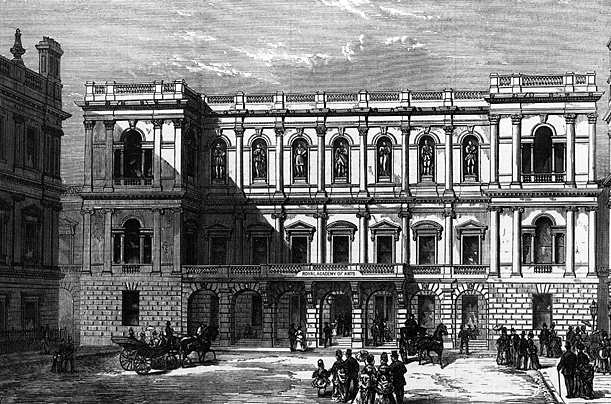
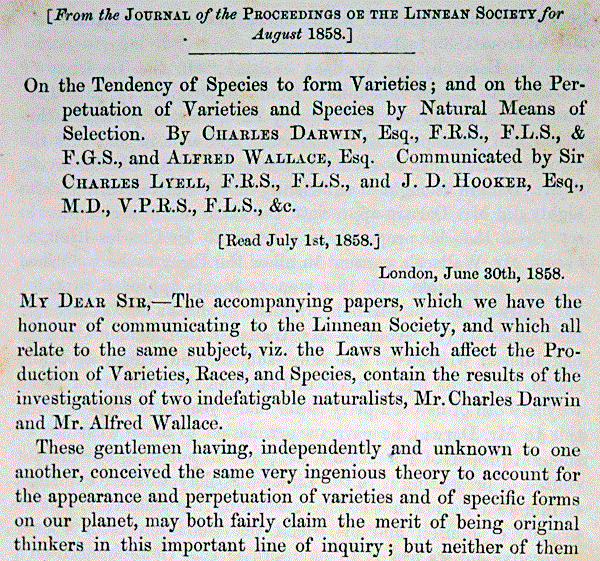
On July 1, 1858, a joint paper by Wallace and Darwin was read
to a meeting of the Linnean Society of London
held at Burlington House, (pictured above).
Neither Wallace nor Charles Darwin were present at the meeting when papers attributable to each were brought to the attention of the wider scientific public - in the form of the thirty or so persons who were gathered together on that date in Burlington House, London.
Although the Theory of Evolution would, in time, have immense repercussions on the biological sciences as well as on wider society we have three unimpeachable testimonies that the meeting of July 1858 itself caused very little controversy, or even much in the way of interest, to emerge.
The paper was reprinted and reviewed in several magazines including The Zoologist, and was commented on in some reviews and letters but the reaction was generally quite muted. The Linnean Society President, Thomas Bell, even went so far as to write that "The year which has passed has not, indeed, been marked by any of those striking discoveries which at once revolutionize, so to speak, the department of science on which they bear" in his Linnean Society presidential report of May 1859.
Charles Darwin himself in his Autobiography (1887) wrote:-
The circumstances under which I consented at the request of Lyell and Hooker
to allow of an abstract from my MS., together with a letter to Asa Gray, dated
September 5, 1857, to be published at the same time with Wallace's Essay, are
given in the 'Journal of the Proceedings of the Linnean Society,' 1858, page 45.
I was at first very unwilling to consent, as I thought Mr. Wallace might
consider my doing so unjustifiable, for I did not then know how generous and
noble was his disposition. The extract from my MS. and the letter to Asa Gray
had neither been intended for publication, and were badly written. Mr. Wallace's
essay, on the other hand, was admirably expressed and quite clear. Nevertheless,
our joint productions excited very little attention, and the only published
notice of them which I can remember was by Professor Haughton of Dublin, whose
verdict was that all that was new in them was false, and what was true was old.
This shows how necessary it is that any new view should be explained at
considerable length in order to arouse public attention.
Also in 1887 Hooker provided a recollection of the meeting to Charles Darwin's son Francis Darwin:
The interest excited was intense, but the subject was too novel and too ominous for the old school to enter the lists,
before
armouring. After the meeting it was talked over with bated breath: Lyell's approval, and perhaps in a small way mine,
as his lieutenant in the affair,
rather overawed the Fellows, who would otherwise have flown out against the doctrine. We had, too, the vantage ground of
being familiar with the authors and their theme.
Wallace was several weeks letter-delivery time away in
the Moluccas and efforts were made by Darwin, Lyell and Hooker to keep him informed
of developments in London in relation to his sending his manuscript to Charles Darwin.
On October 6, 1858, Wallace wrote in a fairly magnanimous spirit to Hooker:-
My dear Sir
I beg leave to acknowledge the receipt of your letter of July last, sent me by Mr. Darwin, & informing me of the steps you had taken with reference to a paper I had communicated to that gentleman. Allow me in the first place sincerely to thank yourself & Sir Charles Lyell for your kind offices on this occasion, & to assure you of the gratification afforded me both by the course you have pursued, & the favourable opinions of my essay which you have so kindly expressed. I cannot but consider myself a favoured party in this matter, because it has hitherto been too much the practice in cases of this sort to impute all the merit to the first discoverer of a new fact or new theory, & little or none to any other party who may, quite independently, have arrived at the same result a few years or a few hours later.
I also look upon it as a most fortunate circumstance that I had a short time ago commenced a correspondence with Mr. Darwin on the subject of "Varieties," since it has led to the earlier publication of a portion of his researches & has secured to him a claim of priority which an independent publication either by myself or some other party might have injuriously effected;- for it is evident that the time has now arrived when these and similar views will be promulgated & must be fairly discussed.
It would have caused me much pain & regret had Mr. Darwin's excess of generosity led him to make public my paper unaccompanied by his own much earlier & I doubt not much more complete views on the same subject, & I must again thank you for the course you have adopted, which while strictly just to both parties, is so favourable to myself.
Following on from Wallace's initial approach Darwin, besides
preparing a paper that was read to the Linnean Society, made
efforts to draw together what he himself later referred to as an "abstract" out from his extensive research notes into a work of sufficient
authority and completeness for
publication.I beg leave to acknowledge the receipt of your letter of July last, sent me by Mr. Darwin, & informing me of the steps you had taken with reference to a paper I had communicated to that gentleman. Allow me in the first place sincerely to thank yourself & Sir Charles Lyell for your kind offices on this occasion, & to assure you of the gratification afforded me both by the course you have pursued, & the favourable opinions of my essay which you have so kindly expressed. I cannot but consider myself a favoured party in this matter, because it has hitherto been too much the practice in cases of this sort to impute all the merit to the first discoverer of a new fact or new theory, & little or none to any other party who may, quite independently, have arrived at the same result a few years or a few hours later.
I also look upon it as a most fortunate circumstance that I had a short time ago commenced a correspondence with Mr. Darwin on the subject of "Varieties," since it has led to the earlier publication of a portion of his researches & has secured to him a claim of priority which an independent publication either by myself or some other party might have injuriously effected;- for it is evident that the time has now arrived when these and similar views will be promulgated & must be fairly discussed.
It would have caused me much pain & regret had Mr. Darwin's excess of generosity led him to make public my paper unaccompanied by his own much earlier & I doubt not much more complete views on the same subject, & I must again thank you for the course you have adopted, which while strictly just to both parties, is so favourable to myself.
That work was prepared and published under the title On the Origin of Species by Means of Natural Selection, or the Preservation of Favoured Races in the Struggle for Life was first published on 24 November 1859. There were only 1,250 copies published in this first edition, and Darwin had suggested to his publisher that even this would be too many for what he presumed to be a limited market.
Although the book was priced at fourteen shillings - more than a week's wages for a labourer and hence beyond most persons convenient means - and its content was slightly technical this edition sold out to the book trade on the day of publication.
A second edition of 3,000 copies was issued some two months later.
Few books have had such a profound and far-reaching impact on Human Society across the world.
To quote Charles Darwin, (from his Autobiography), again:-
In September 1858 I set to work by the strong advice of Lyell and Hooker to
prepare a volume on the transmutation of species, but was often interrupted by
ill-health, and short visits to Dr. Lane's delightful hydropathic establishment
at Moor Park. I abstracted the MS. begun on a much larger scale in 1856, and
completed the volume on the same reduced scale. It cost me thirteen months and
ten days' hard labour. It was published under the title of the 'Origin of
Species,' in November 1859. Though considerably added to and corrected in the
later editions, it has remained substantially the same book.
It is no doubt the chief work of my life. It was from the first highly successful. The first small edition of 1250 copies was sold on the day of publication, and a second edition of 3000 copies soon afterwards. Sixteen thousand copies have now (1876) been sold in England; and considering how stiff a book it is, this is a large sale. It has been translated into almost every European tongue, even into such languages as Spanish, Bohemian, Polish, and Russian. It has also, according to Miss Bird, been translated into Japanese* (*Miss Bird is mistaken, as I learn from Prof. Mitsukuri.-F.D.), and is there much studied. Even an essay in Hebrew has appeared on it, showing that the theory is contained in the Old Testament! The reviews were very numerous; for some time I collected all that appeared on the 'Origin' and on my related books, and these amount (excluding newspaper reviews) to 265; but after a time I gave up the attempt in despair. Many separate essays and books on the subject have appeared; and in Germany a catalogue or bibliography on "Darwinismus" has appeared every year or two.
The success of the 'Origin' may, I think, be attributed in large part to my having long before written two condensed sketches, and to my having finally abstracted a much larger manuscript, which was itself an abstract. By this means I was enabled to select the more striking facts and conclusions.
It is no doubt the chief work of my life. It was from the first highly successful. The first small edition of 1250 copies was sold on the day of publication, and a second edition of 3000 copies soon afterwards. Sixteen thousand copies have now (1876) been sold in England; and considering how stiff a book it is, this is a large sale. It has been translated into almost every European tongue, even into such languages as Spanish, Bohemian, Polish, and Russian. It has also, according to Miss Bird, been translated into Japanese* (*Miss Bird is mistaken, as I learn from Prof. Mitsukuri.-F.D.), and is there much studied. Even an essay in Hebrew has appeared on it, showing that the theory is contained in the Old Testament! The reviews were very numerous; for some time I collected all that appeared on the 'Origin' and on my related books, and these amount (excluding newspaper reviews) to 265; but after a time I gave up the attempt in despair. Many separate essays and books on the subject have appeared; and in Germany a catalogue or bibliography on "Darwinismus" has appeared every year or two.
The success of the 'Origin' may, I think, be attributed in large part to my having long before written two condensed sketches, and to my having finally abstracted a much larger manuscript, which was itself an abstract. By this means I was enabled to select the more striking facts and conclusions.