
Revolutionary turmoil
The Italian States in 1848
In order to more fully understand how revolutionary events unfolded in the Italian peninsula it is perhaps particularly worthwhile to consider how historically ready various sections of the population, living within the states established on the peninsula, were to be motivated by liberalist, constitutionalist and nationalist aspirations and to offer unmistakable defiance to governmental authority as a result.
Metternich regarded the establishment of an Austrian hegemony of influence over the affairs of the Italian peninsula as having been a major diplomatic victory achieved at the Congress of Vienna that was held in 1815 after Napoleon Bonaparte was seen to have been defeated. This was secured principally through the re-acquisition of Lombardy and Venetia, both of which were notably populous, fertile and commercially accomplished regions.
Taken together Lombardy and Venetia, in 1848, were so populous as to be home to about one sixth of the persons then subject to Habsburg sovereignty and so prosperous, and so subject to taxations, as to contribute almost one third of the Habsburg monarchy's overall tax revenues.
Lombardy and Venetia were constituted as a Kingdom of Lombardy-Venetia after 1815. Milan, the capital of Lombardy, prospered but Venice, the chief city of Venetia, declined partly as Habsburg policies favoured the development of a newly established mainland port at Trieste to attempting to revive trade at Venice (an island city surrounded by some shallow seas).
A railway bridge linking Venice with the mainland had been constructed and was operational after 1846.
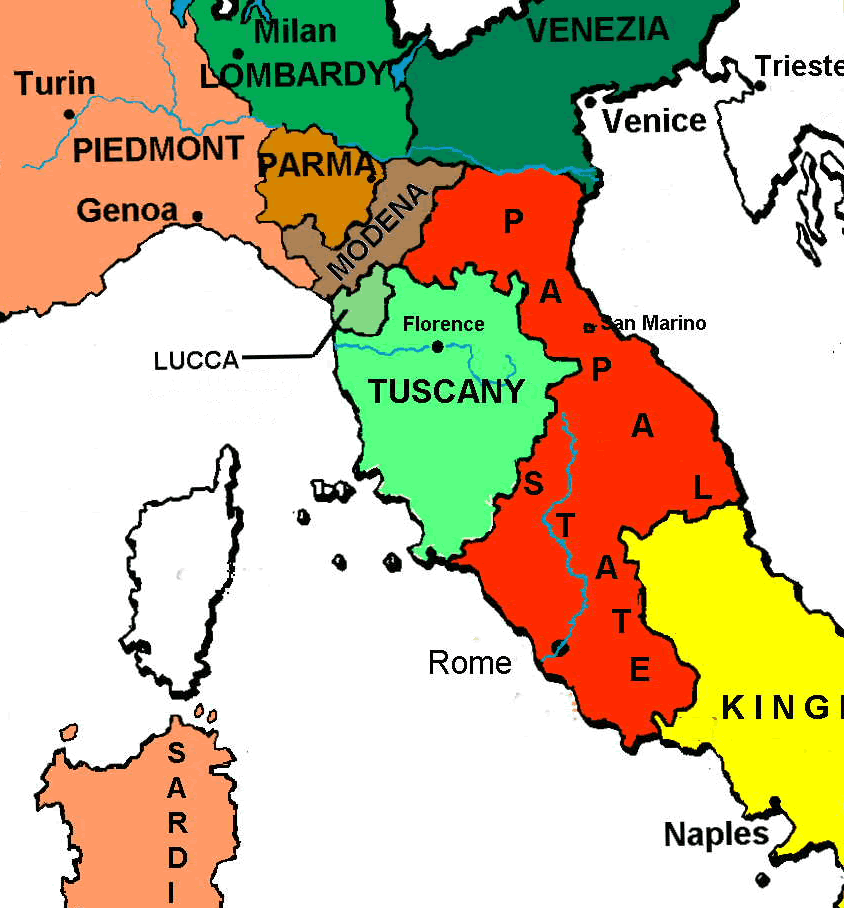
The Grand Ducal and Ducal thrones of such smaller historic Italian states as Modena, Parma and Tuscany were awarded to junior branches of the House of Habsburg. The territories of another historic Italian state - the Republic of Genoa - were entrusted to the sovereignty of the Kingdom of Piedmont-Sardinia.
As may well be appreciated the dynastic politics of yester-year was somewhat complex - featuring transfers of territories, and of titles, for historic, political or dynastic reasons.
The direct ancestors of the Kings of Piedmont-Sardinia had "only" been Dukes - of Savoy. Significant extensions of territory south of the Alps in earlier times had contributed to an upgrading, with the consent of other European sovereigns, of the House of Savoy to Kingship in 1713!!!
That senior title of Kingship referred to Kingship over Sicily but this was transferred to Kingship over Sardinia before many years had passed. History books, considering the subsequent history of the Kingdom of Sardinia, use a range of terms such as Piedmont-Sardinia, Piedmont or Sardinia.
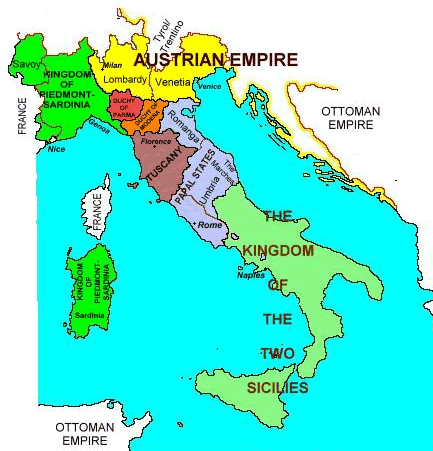
During the French Revolutionary and Napoleonic era 1789-1815 Naples had often been under French control and even spent time under the sovereignty of a Bonaparte, brother to Napoleon, and was at another time placed under the sovereignty of Murat, a former Napoleonic field marshal.
Sicily meanwhile, separated from the peninsula by the Straits of Messina, was enabled by British naval interventions during those times, to function independently and featured governance under a locally operative and somewhat liberal constitution of 1812.
After 1815, however, a bourbon dynasty was restored to its historic sovereignty over the so-called "Kingdom of the Two Sicilies", (i.e. Sicily and Naples).
Whilst, after 1815, Metternich had sought to formalise the construction of an "Italian Federation" this was blocked by the King of Piedmont-Sardinia's, and the Papacy's, reluctance to accept an associated Habsburg presidency of the federation.

It happened, however, that in establishing a predominance of Habsburg influence in relation the affairs of the Italian peninsula after 1815 Metternich brought difficulties, as well as benefits, upon the Habsburg state system as his subsequent policy was constantly being made more complicated by a rising tide of constitutional / liberal / national aspiration being shown by diverse sections of the population living on the Italian peninsula.
Following on from a liberal and constitutionalist revolt in Naples a Congress of Troppau of 1820 recognised "Members of the European Alliance" (i.e. The post Napoleonic Wars European Alliance of conservative / reactionary Monarchies / Empires) as having a "right of intervention" in the political affairs of states where revolutionary activity was deemed to have become threatening to other states.
The main pronouncement of the "Troppau Protocol" is as follows:-
"States, which have undergone a change of government due to revolution, the result of which threaten other states, ipso facto cease to be members of the European Alliance, and remain excluded from it until their situation gives guarantees for legal order and stability. If, owing to such alterations, immediate danger threatens other states the powers bind themselves, by peaceful means, or if need be, by arms, to bring back the guilty state into the bosom of the Great Alliance."
Such an intervention actually took place in
the 1830s when turmoil broke out in several central Duchies and in some of the territories of the Papal States.
"States, which have undergone a change of government due to revolution, the result of which threaten other states, ipso facto cease to be members of the European Alliance, and remain excluded from it until their situation gives guarantees for legal order and stability. If, owing to such alterations, immediate danger threatens other states the powers bind themselves, by peaceful means, or if need be, by arms, to bring back the guilty state into the bosom of the Great Alliance."
In May, 1831, in the aftermath of such disturbances, Austria, Russia, France, Great Britain and Prussia presented a joint Memorandum through their respective diplomats, to the Papacy, recommending reforms whereby councils could be elected by local populations to assist in local government, a central body, composed partly of elected representatives, would have a role in controlling finance, and the predominant position in the administration and in the judicial system that had long been entrusted to clerics would be discontinued.
Such recommendations were intended to produce a forms of civil and judicial administration that would be more acceptable to the local populations of the Papal States but were largely declined by the then Pope Gregory XVI.
There were aspirations expressed, in Lombardy and more widely in the Italian peninsula, for liberty and greater independence. An "Italian" cultural enthusiasm found literary and other forms of expression. A secret Society of the Carbonari spread out from its initial foundation in Naples into Lombardy and Piedmont and attempted to champion what it saw as the cause of liberty.
A newer secret society "Young Italy" (La Giovine Italia) was founded by Giuseppe Mazzini, (a former Carbonaro who had been forced into exile), in Marseille in July 1831. "Young Italy" was uncompromisingly dedicated to the unification of Italia, (preferably as a republic rather than a monarchy), and prepared to engage in insurrection in efforts to achieve its aims.
The following sentences appear in Mazzini's
'General Instructions for members of Young Italy' of 1831.
"...Young Italy is a brotherhood of Italians who are convinced that Italy is destined to become one nation - convinced also that she possesses sufficient strength within herself to become one. The great aim is to remake Italy as one independent sovereign nation of free men and equals.
Young Italy is Republican because it is the only form of government that ensures a free and equal community of brothers and the aristocracy is the source of inequality and corruption of the whole nation.
Young Italy is Unitarian because without unity there is no true nation or strength. Italy, surrounded by powerful nations, has need for strength. Federalism would place her under the influence of one of the neighbouring nations.
The means by which Young Italy proposes to reach its aims are education and insurrection. Education must always be directed to teach by example, word and pen, the necessity of insurrection. Insurrection - by means of guerrilla bands - is the true method of warfare for all nations wanting to free themselves from foreign control.
Young Italy's policies were thus effectively decidedly opposed to the continued existence of each and every one the then established states of the peninsula preferring that a single "Italian" state should take their place!!!
'General Instructions for members of Young Italy' of 1831.
"...Young Italy is a brotherhood of Italians who are convinced that Italy is destined to become one nation - convinced also that she possesses sufficient strength within herself to become one. The great aim is to remake Italy as one independent sovereign nation of free men and equals.
Young Italy is Republican because it is the only form of government that ensures a free and equal community of brothers and the aristocracy is the source of inequality and corruption of the whole nation.
Young Italy is Unitarian because without unity there is no true nation or strength. Italy, surrounded by powerful nations, has need for strength. Federalism would place her under the influence of one of the neighbouring nations.
The means by which Young Italy proposes to reach its aims are education and insurrection. Education must always be directed to teach by example, word and pen, the necessity of insurrection. Insurrection - by means of guerrilla bands - is the true method of warfare for all nations wanting to free themselves from foreign control.
Young Italy's policies were thus effectively decidedly opposed to the continued existence of each and every one the then established states of the peninsula preferring that a single "Italian" state should take their place!!!
Lombard and Venetian public opinion, and public opinion in the Italian peninsula generally, tended to tolerate rather than to welcome Habsburg influence over the political and economic affairs of the peninsula. The Habsburgs often tried to behave in a conciliatory fashion in some matters but for a variety of reasons, including the high levels of taxation imposed and the many restrictions placed by the Austrians on educational, intellectual and political life, tended to fail to win local support.
In 1831 a scion of the House of Savoy named Charles Albert succeeded a distant cousin as King of Piedmont-Sardinia and shortly thereafter was addressed by an open letter from Mazzini, the contents of which were made known to the wider public, (Mazzini having direct access to Young Italy's revolutionary journalism), and featured such passages as:-
"...There is not a heart in Italy whose pulse did not quicken at the news of your accession. There is not an eye in Europe that is not turned to watch your first steps in the
career now open to you..."
"...The people are no longer to be quieted by a few concessions. They seek the recognition of those rights of humanity which have been withheld from them for ages. They demand laws and liberty, independence and union. Divided, dismembered, and oppressed, they have neither name nor country. They have heard themselves stigmatised by the foreigner as the Helot Nation. They have seen free men visit their country, and declare it the land of the dead. They have drained the cup of slavery to the dregs; but they have sworn never to fill it again..."
"...Sire, I have spoken to you the truth. The men of freedom await your answer in your deeds. Whatever that answer be, rest assured that posterity will either hail your name as the greatest of men, or the last of Italian tyrants. Take your choice..."
Mazzini's letter concluded on an unmistakeably threatening note:-
"...If you do not act, others will, without you and against you."
Charles Albert responded to this letter by extending Mazzini's sentence of banishment and by encouraging the French authorities
to take action against him - with the result that Mazzini chose to live a very clandestine life in order to continue living in
Marseilles.
"...The people are no longer to be quieted by a few concessions. They seek the recognition of those rights of humanity which have been withheld from them for ages. They demand laws and liberty, independence and union. Divided, dismembered, and oppressed, they have neither name nor country. They have heard themselves stigmatised by the foreigner as the Helot Nation. They have seen free men visit their country, and declare it the land of the dead. They have drained the cup of slavery to the dregs; but they have sworn never to fill it again..."
"...Sire, I have spoken to you the truth. The men of freedom await your answer in your deeds. Whatever that answer be, rest assured that posterity will either hail your name as the greatest of men, or the last of Italian tyrants. Take your choice..."
Mazzini's letter concluded on an unmistakeably threatening note:-
"...If you do not act, others will, without you and against you."
"Italians" connected to Giuseppe Mazzini's Young Italy movement attempted to pursue a revolutionary course in 1834 but their armed rising was contained by Piedmontese-Sardinian forces.
Mazzini's philosophy actually spread beyond Italia to become a wider "Young Europe" movement with several "national" branches after 1835. The wider "Young Europe" movement held that peoples were to help each other in developing their own national life after their own fashion, and to respect "each other's national claims as they claimed respect for their own".
It happened that within the Kingdom of Piedmont-Sardinia, the most potent "Italian" state, King Charles Albert went on to maintain a social order that was just as favourable to aristocratic privileges and just as restrictive of educational, intellectual and political life, in the interests of societal conservatism, as that maintained by Metternich's administrators in Lombardy and Venetia.
All in all then, although the Carbonari and Young Italy movements had relatively few active supporters, the Habsburg administration in Lombardy and Venetia, and the administrations in several Italian states acted to closely supervise intellectual and political life with a view to lessening, through the imprisonment or exile of the supporters of liberal, constitutional or nationalist movements, their potential for attempting to openly seek dramatic changes in the ways in which the Italian States were governed.
Sentences of imprisonment or exile were often imposed by administrators on grounds of strong suspicion only and without recourse to any perceived necessity for verdicts of guilt being arrived at through open courtroom proceedings.
Prelude to the Revolutionary events
in the Italian peninsula in 1848
In the Italian peninsula there were far-reaching developments
based to some appreciable extent on aspirations which definitely
stirred more openly into life shortly after the time of the election in June
1846, as Pope Pius IX, of a Cardinal who followed policies which
led to his being perceived as holding liberal views. Prior to his
demise in 1846 the previous Pope, Gregory XVI, backed by a sure
reliance on Prince Metternich's Austria for support, had been
responsible for establishing a pervasively repressive
administration where spies and informers could ensure that
liberals, nationalists, and intellectuals, were often harassed
and routinely subjected to punishments that were not actually within the laws.
By the authority of the incoming Pope there was a declaration, on July 17th 1846, of an amnesty. Amnesties, as such, were usually declared after Papal elections, (and indeed were traditional in association with changes of sovereign in several European states), but this amnesty was unusual in being extended to many sentenced for political crimes.
As a result some 394 persons languishing in prison after being convicted of offences deemed political were, after promising good behaviour, released from imprisonment, and a further 477 persons were allowed to return from foreign exile. The Papal States, recently remarkable for political repression, now saw a degree of political freedom and a relaxation of previously strict censorship.
Opinion amongst the informed public in the Italian peninsula had already been recently influenced by several aspirational publications and notably so by one written by Vincenzo Gioberti entitled "On the Civil and Moral Primacy of the Italians". This work, (first published in 1843 and which sold to the extent of some eighty-thousand copies by 1848), considered the past greatness of Italia and her present virtues, deemed that Italians were capable of resuming leadership of the civilised world, and looked to Piedmont-Sardinia and its army to stand up to the Austrian Empire. Pope Pius IX was familiar with the content of this publication that favoured the formation of a league of Italian rulers under the political and moral authority of the Papacy.
The Papacy is a concrete, living thing, real - not just an idea. It has existed for eighteen centuries.
The Papacy is naturally the head of Italy. This is in the nature of things, confirmed by many centuries of history. It has only been questioned by those who were too friendly with foreign powers and were enemies of Italy. The benefits Italy would gain from a political confederation under the Pope are endless. For such a co-operative association would increase the strength of the various princes without damaging their independence and would put the strength of each at the disposal of all. It would make foreign invasion impossible and place Italy again in the first rank of the Powers.
From Vincenzo Gioberti -
On the Civil and Moral Primacy of the Italians, 1843
The incoming Pope had in fact, prior to his election, brought copies of several such
works to the Conclave of Cardinals at which he himself was somewhat unexpectedly
elected Pope with the view of keenly recommending them to whosoever
was returned to the Papal dignity.The Papacy is naturally the head of Italy. This is in the nature of things, confirmed by many centuries of history. It has only been questioned by those who were too friendly with foreign powers and were enemies of Italy. The benefits Italy would gain from a political confederation under the Pope are endless. For such a co-operative association would increase the strength of the various princes without damaging their independence and would put the strength of each at the disposal of all. It would make foreign invasion impossible and place Italy again in the first rank of the Powers.
From Vincenzo Gioberti -
On the Civil and Moral Primacy of the Italians, 1843
During his first few months in office Pope Pius followed progressive policies such as the promotion of railways, of gas-lighting, of an Agricultural Institute, and of some form of lay consultation in the administration of the States of the Church, on July 5th, 1847 the Pope granted a civic guard to Rome, and promised one to the provincial regions of the states of the church, all of which lent credibility, in many people's eyes, to the wider political authority of his papacy.
Other rulers in the Italian peninsula were affected by the changed times - in the city of Turin in Piedmont, from where Charles Albert King of Sardinia, ruled in Piedmont, Genoa, Sardinia, Nice and Savoy, there was an extension of press freedoms. Amongst the persons who involved themselves in press activity was a Count Camillo di Cavour, who had ownership links with a liberal leaning newspaper called Il Risorgimento (Resurrection) which demanded a Constitution, supported industrial development, and encouraged the speaking of Tuscan-Florentine originated "Italian" rather any of the many other strongly established regional dialects then in everyday use in the Italian peninsula.
Although all of the historic dialects of the peninsula are quite strongly related through common descent from Latin, the nineteenth century, particularly during the events of 1848 and in their aftermath, was a century of emergent nations, nationalism and nation-building. In the case of would-be free and independent "Italia" the literary version of the Tuscan-Florentine dialect was seen as the best candidate for acceptance as "The Italian Language" having been brought to prominence and made popular centuries previously by such important figures as Dante, Petrarch and Boccaccio, and further brought into widespread usage, in those times, by the wider implications of the power and influence of Florence as a trading centre.
The "popular republicanist" Mazzini, although poles apart politically from Cavour, who favoured the establishment of a liberal constitutional monarchy, had already blazed a trail for the acceptance of Tuscan-Florentine as being recognised as "Italian" - "La Giovine Italia" being "Italian" for "Young Italy".
The synthesis of a very lively, supple and expressive unified Italian language had actually been a major goal of a recently prominent literary figure named Alessandro Manzoni, who had helped to transform somewhat unwieldy literary "Tuscan-Florentine" through the readability and popularity of his famous novel The Betrothed, (orig. Italian: I Promessi Sposi).
First published in 1827 and extensively revised in the following years the focus of this novel is set in northern Italy in 1628, during the oppressive years under Spanish rule, it is sometimes seen as a veiled attack on Austria, which controlled the region at the time the novel was written. The 1840 version of I Promessi Sposi used what was becoming a standardized version of the Tuscan dialect that can be seen as the outcome of a conscious effort by the author to provide a language for "Italians".
Metternich saw the Italian peninsula as being "at the mercy of flagrant revolution."
On July 17th 1847, (the first anniversary of the papal amnesty), against this background of Austrian concern, Field Marshall Radetzky, the Austrian commander in Lombardy, very publicly reinforced the Austrian garrison in Ferrara, a fortress within the Papal territory of Romagna just across the border from Venetia. Although an Austrian garrison was allowed to be present in the Citadel of Ferrara in line with the provisions of the treaties framed at the close of the Napoleonic Wars the public nature and the timing of this process of reinforcement was seen as provocative by "Italian" opinion. After the Austrians moved to secure several strategic points outside the Citadel "to protect their men from insult" Pope Pius personally protested to the European powers.
King Charles Albert of Piedmont-Sardinia also offered public criticisms.
These protests were welcomed and supported by many in the Italian Peninsula.
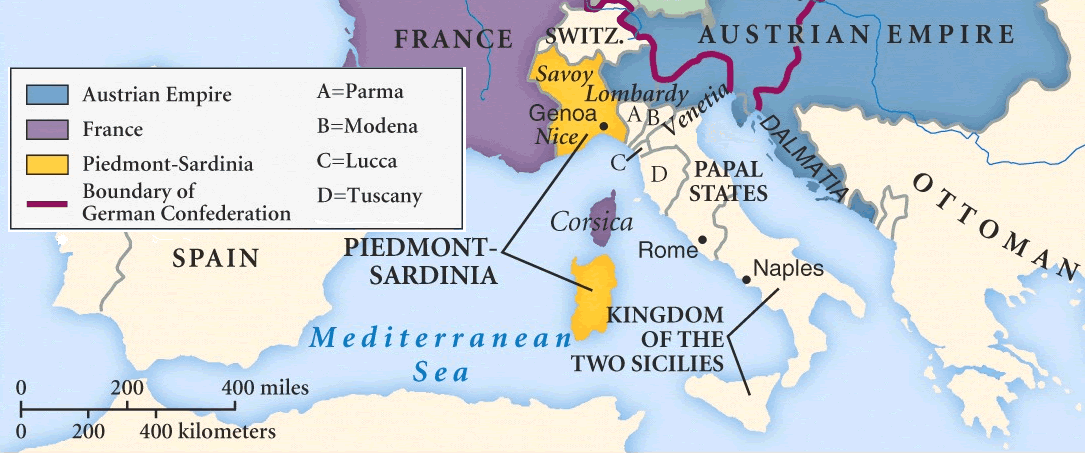
In Tuscany itself, although then under the sovereignty of a cousin of the Austrian emperor, freedom of the press was granted, (leading to the foundation of many new journals), and the establishment of a civic guard was conceded. Similar reforms took place in the tiny Duchy of Lucca, by popular demand, leading to the abdication of its ruler amidst a hornet's nest of controversies over which other ruler ought to now control his former dominions (and also the Duchy of Parma which coincidentally fell to him at this very time by way of inheritance).
In January 1848 some sixty-one persons were seriously injured, resulting in a number of fatalities, during so-called "tobacco riots" in Milan, then the chief city of the Italian Peninsula in terms of economic activity, as people demonstrated against such things as the high taxes imposed by Lombardy's Austrian authorities who maintained a state monopoly on tobacco sales.
(The Milanese had initiated a boycott on tobacco and lottery purchases as a form of protest, from 1st January, 1848, whereupon the situation was perhaps not helped by a number of small groups of Austrian soldiers appearing in the streets of Milan the very next day ostentatiously smoking the addictive leaves that the Milanese were now supposed to deny to themselves, and to their fellow Milanese by pressuring those who did not observe the boycott to extinguish any tobacco they were caught smoking).
Rioting seems to have broken out on the 3rd after some Milanese threw protesting and insulting language or stones at the soldiers and the insulted, (and somewhat threatened), soldiers retaliated with their swords. The first fatalities took place and moderate Milanese opinion, previously largely accepting of the Austrian administration in Lombardy, was alienated and became much more open to questioning the value and validity of Austrian influence in Lombardy-Venetia.
Whilst taxes, (on tobacco and salt - and a probably demoralizing and corrupting Austrian sponsored state lottery), were prominent as the superficial focus of Milanese discontent a broader political and cultural agenda underlay these protests.
In early December, 1847, Giambattista Nazari, a lawyer of Treviglio had addressed a largely advisory forum known as the Central Congregation of Lombardy to which he had recently been elected and encouraged the collection of a list of grievances felt by the inhabitants to be brought to the attention of the authorities. Nazari maintained that he made this appeal "from a desire for the public good, from affection for my Prince, and from a sentiment of duty" but given the heightened expectations now stirring in the Italian Peninsula Nazari's call for the collection and presentation of a list of grievances tended to wake what had been a quiescent forum into more strident advocacy.
One petition elicited by the Central Congregation of Lombardy's investigations maintained that:-
"...all these evils spring from the first great falsehood of a people that has not the life of a people, of a kingdom that has not the life of a kingdom. Lombardy is governed by
foreign laws and foreign persons. It is taxed for the benefit of Austrian industries, while a barrier of customs duties separates it from Italy."
and came out in favour of:-
"A complete and irrevocable separation in every branch of the administration; that they should be governed by a person, not by a foreign people;"
and maintained that:-
"their own nationality, history, language, and brotherhood with other Italians should not be considered as crime and rebellion."
On January 8, 1848, a lawyer named Daniel Manin sent in a petition to the Venetian Congregation setting out what he regarded as being a necessary programme of reform.and came out in favour of:-
"A complete and irrevocable separation in every branch of the administration; that they should be governed by a person, not by a foreign people;"
and maintained that:-
"their own nationality, history, language, and brotherhood with other Italians should not be considered as crime and rebellion."
Manin demanded that the territories of Lombardy and Venetia should form a separate kingdom, not a province,
"still less a mere outlying village of Vienna. We ought to be governed according to our character and customs; to have a true national representation, and a moderately free
press which could control and enlighten the chiefs of the Government and the representatives of the nation."...
On 12th January there was a rising in Palermo on the island of
Sicily, then a notably populous city, and a principal seaport,
against the absolutist King Ferdinand with outcomes including
a Sicilian
declaration of independence and the awardance, by King
Ferdinand, of such concessions as a Constitution, freedom of the press, and the formation of a citizen national guard to Naples on the 29th of
January.
This concession of constitutional governance, against his will, by a King who was not only a member of a historic and proud Bourbon dynasty but also personally notorious as a reactionary ruler, was a fact which naturally seemed to be immensely significant. Constitutional and liberal change which had seemed impossible before now seemed to be more attainable, and even to be expected, in all parts of the Italian peninsula.
Many members of the civilian civic guard in Rome, that had been authorised in mid 1847 by Pope Pius as a liberalising concession, discarded the white and yellow "papal" cockades that had embellished their hats only to replace them with "Italian" tricolour emblems.
The Sicilian rising had a Sicilian rather than an "Italian" focus being motivated by a deep dislike of being governed by King Ferdinand, and a desire to restore a relatively liberal constitution of 1812. By the end of January the Sicilian insurgents had overcome the remaining forces of King Ferdinand that were based there, with the exception of a fortress at Messina, and found themselves able to attempt to make arrangements for their own future governance.
The Sicilians were now able to resuscitate the constitution of 1812, which provided for representative democracy and a central role for a Parliament in the governance of the state. Sicilian liberals, perhaps concerned about the possibility of radical measures being proposed by fellow Sicilians, were heard to champion moves towards the foundation of a confederation of all the states of the Italian peninsula, (which they hoped would be somewhat conservatively inclined).
The existence of "Italy" was denied by the Austrians to the extent that such denial was actually to be enforced through censorship and statutes of law, (although both censorship and laws in this regard were somewhat ineffectually applied).
In April, 1847 Metternich wrote something on this theme in a letter to one of his officials:-
The word Italy is a geographical expression. Though it is a term that slides easily off the tongue, it has none of the
political implications which the revolutionaries are trying to attach to it - implications which would threaten the very
existence of the individual states which make up the Italian peninsula.
In Rome the Pope gave way to popular clamour, granting one concession after another, and actually concluded an Allocution issued
on the 10th of February with the expression "O Great God, bless Italy and preserve for her always this the most precious of
all gifts, the Faith".
This was seized upon by the nationalistically inclined who interpreted it as a blessing on Italian national aspirations.
Unauthorised patriotic pictures were widely published depicting the Pope and with such things as swords, cannon and "Italian" flags being plainly evident in the background.
The hopes of would-be constitutional and liberal reformers in the wider Italian peninsula were further raised by the fact that Grand-Duke Leopold II of Tuscany also conceded constitutional governance on 11 February, 1848, and that popular pressures seemed to be obliging the King of Piedmont-Sardinia to also consent to the granting of a form of constitutional rule. On March 4th Charles Albert of Piedmont-Sardinia issued a conservative constitutional document known as the Statuto which envisaged one of the two proposed legislative chambers being elected by persons who had an adequate level of literacy and also paid a certain amount in taxes.
Whilst Pope Pius himself seemed to hope to somehow reconcile the Church and Liberalism without diminishing the Church's authority, the people increasing sought to gain the Church's support for democratic reforms and for Italian nationalism. On 14th March the States of the Church centred on Rome were awarded a Constitution, known as the Fundamental Statute, which had been drawn up by a commission of Cardinals. This constitution allowed for some participation of elected deputies in legislation. There were to be restrictions on voting rights. The Ministry of the States of the Church, previously exclusively clerical, now featured many lay persons.
European Revolutionary events spill over
into the Italian peninsula in 1848
After mid-March when news of recent serious civil unrest in Vienna, (including the fall from power of Metternich - much disliked by
liberals in the Italian peninsula), reached Milan there was civil turmoil
where an estimated ten thousand persons actively sought the the freedom of the press, the replacement of the existing police force by a
newly formed civil guard and the convening of a national assembly.
The Austrian commanders were initially somewhat unprepared to meet the protests head-on and, after an attack on the government offices which resulted in fatalities amongst the guards placed there, a captured Austrian administrator made concessions to the protestors including the signing of proclamations of the establishment of a Provisional Government and of a National Guard.
The Austrian military commander Radetzky, however, continued to attempt to regain control with the result that over some two or three days of intense combat Austrian forces attempted to suppress those opposed to the Austrian hold over that city. In the event Radetzky's forces based in Milan itself, estimated at 13,000 and recruited from many of the Habsburg Empire's peoples, suffered from a significant number of, mainly "Italian", desertions whilst there was a real threat that the Piedmontese-Sardinian Kingdom, with its tens of thousands strong armed forces, could intervene against the Austrian interest. Also of concern was the many attacks being suffered by Austrian forces in the Milanese countryside threatening the mobility of outlying groups of soldiers and the availability of food supplies being able to reach Milan to feed Radetzky's forces.
Given these considerations Austrian forces in Lombardy were withdrawn from the city.
Radetzky had long regarded Austrian retention of Milan as being critical to Austria's position as master of the peninsula. He had given the Emperor an absolute commitment to the city's defence. Nevertheless Austrian History archives record that on March 22 Radetzky wrote:-
It is the most frightful decision of my life, but I can no longer hold Milan. The whole country is in revolt. I am pressed in the rear by the Piedmontese. All the bridges behind me can easily
be cut, and I have no timber for replacing them. Similarly I have very little transport. What is going on in my rear I just do not know. I shall withdraw toward Lodi to avoid the large towns
and while the countryside is still open.
Also on March 22, 1848, revolution broke out in Venice and a Venetian Republic was re-established.
Austrian military withdrawals continued and resulted in a movement of the bulk of the army basing itself upon a group of fortresses known as the Quadrilateral.
The fortresses are shown, on the map below, by this symbol

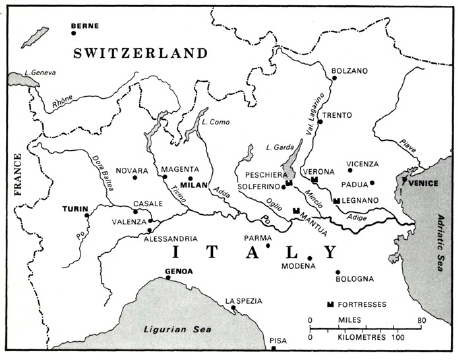
Verona, the principal of these fortresses, lay close to the long-established
overland route between the Italian peninsula and Austria via the Brenner Pass. In these times unrest in Parma and Modena caused their princely rulers to depart and a reborn Venetian Republic was established under the leadership of a lawyer named Daniel Manin.
Armed contingents which it seemed might be used against the Austrian interest marched north from Naples, from Tuscany, and from Rome. One source has it that as the troops departing Rome had filed past him, on March 24, Pope Pius had actually blessed them, but only as the defenders of the Papal territories against assailants.
Mazzini showed up in Milan and offered his services. Milanese conservatives prevailed in declining to take up Mazzini's inevitably "Republican" help.
On 24th March King Charles Albert of Piedmont-Sardinia, significantly motivated by the hope of acquisitions of territory to extend his realms, encouraged by the journalism of the liberal leaning newspaper, Il Risorgimento, but also to some considerable extent fearing domestic unrest centred upon the traditionally radical seaport of Genoa that might have entailed a challenge to his continued rule if he did not join in with the increasingly vocal opposition to Austrian influence, authorised the movement of his forces into Lombardy and published a proclamation promising his help to the Lombards.
People of Lombardy and Venetia, our armies, which were concentrating on your frontier when you acted first by liberating your glorious Milan,
are now coming to offer you in the latter phases of your fight the help which a brother expects from a brother. We will support you in your
desires, confident in the help of the God who has given Pius IX to Italy. In order to show more openly our feelings of Italian brotherhood, we have
ordered our troops as they move into Lombardy and Venice to carry the cross of Savoy imposed on the tricolour of Italy.
From Charles Albert's proclamation.
On 26th March Piedmontese-Sardinian troops entered
Milan.
From Charles Albert's proclamation.
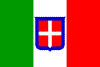 Whilst publicly identifying himself with the cause of "Italia" Charles Albert, in notes sent to other European powers,
maintained that his intervention was intended to deter the revolt in Milan from becoming republican in its policies and actions.
Whilst publicly identifying himself with the cause of "Italia" Charles Albert, in notes sent to other European powers,
maintained that his intervention was intended to deter the revolt in Milan from becoming republican in its policies and actions.
In Milan a situation emerged where local conservatives were somewhat inclined to accept some sort of fusion with Piedmont whereas local radicals tended to prefer the formation of some form of Lombard Republic.
It should not be overlooked that, despite the on-going turmoil, Austrian diplomats were attempting to conciliate Italian and Lombard opinion.
On 19 April a proclamation to the "Italians of Lombardy-Venetia" stated:-
"...in the new order of things now established in the Monarchy you will enjoy liberties and guarantees corresponding to your needs
with respect to language, character, and nationality, [all of] which will be protected in the widest sense. The administration will
be entrusted to you under the supremacy of the state. The laws will be made under your influence, the press will be free and those
taxes which press most heavily upon the less leisured and most numerous classes will be especially lightened".
During these times, Ferdinand of Naples, who had never heartily sympathised with the struggles for freedom that were ongoing in several Italian states, was also trying to convey to the Pope a pressing need for suspicion of the designs of Charles Albert towards an aggrandization of Piedmont-Sardinia in the place of what other arrangements, such as the formation of a league of Italian rulers, that those hoping for change might recognise as progress towards Italian freedoms.
The mobilisation of the Roman forces had been somewhat reluctantly consented to by Pope Pius against a background of nationalistic and liberal passions being expressed in Rome.
On 5 April, the general in charge of the papal forces, an officer of Piedmontese origin named Durando, unilaterally told his men that Pope Pius:-
"has blessed your swords, which, united with those of Charles Albert, must move together for the extermination of
the enemies of God and of Italy. Such a war of civilisation against barbarism is not only
national war but also supremely Christian."
Such statements reached the
ears of Austrian Catholics, Austrian churchmen, and Habsburg family members themselves, and threatened to provide the basis for a schism
away from papal authority.
This would have been a remarkable turn of events given that the Austrian State had long been the principal power offering support to the Roman Catholic church, domestically within the Habsburg Empire, within the Italian peninsula, and internationally.
Later in April radicals in Rome pressed the Pope to order the withdrawal of the Papal Ambassador from Vienna. The withdrawal of ambassadors then, and later, was a diplomatic manoeuvre often seen as a prelude to open hostilities.
On the 20th of April, Durando crossed the Po at the request of the Charles Albert, carrying the papal banner beyond the confines of the present Papal States without approval from the Papal authorities.
Pope Pius was appalled by these development and, on 29th April, in an Allocution addressed to the College of Cardinals, expressed a policy that inherently compromised the role in which he had been cast by many as the potential figurehead of Italian nationalism:-
...It is not unknown to you, Venerable Brethren, that ever since the later years of our Predecessor, Pius VII,. the chief Sovereigns of Europe have sought to induce the Apostolic See to adopt, in the administration of civil affairs, such and such modes of proceeding, as more conciliatory, and more conformable to the wishes of the laity, than those in use...
...Accordingly, when, by the inscrutable decree of God, We were put in his place, We at the outset, not stimulated by encouragements or advice, but prompted by our own singular affection towards the people placed under the temporal dominion of the Church, granted more large indulgence to those who had departed from their duty of allegiance to the Pontifical Government; and we subsequently made speed to adopt certain measures, which We had judged conducive in themselves to the prosperity of the people. And the whole of the acts which We have thus performed at the very commencement of our Pontificate, are in thorough correspondence with those most anxious desires of the European Sovereigns.
But after that, by the help of God, our plans had been brought into effect, not only our own people but those of neighbouring States manifested an exulting joy, and applauded Us with public congratulations and testimonials of respect, in such a mode as made it our duty to take care, even in this exalted City, to keep within due bounds popular outbursts, acclamations, and assemblages, that broke forth with an excess of vehemence...
...every one is well aware of those public commotions in the Italian states, to which We have already referred; as well as of the other events which, out of Italy or within it, had, or have since happened. If then, any one will pretend, that what We did in good will at the commencement of our reign has at all opened the way for these events, he can in no way ascribe this to our doing, since our acts have been none other than such as, not We alone, but likewise the Sovereigns before mentioned, had judged to be seasonable for the well-being of our temporal dominions...
...Besides which, the above-mentioned people of Germany could not be incensed with Us, if it had been absolutely impossible for Us to restrain the ardour of those persons, within our temporal sway, who have thought fit to applaud the acts done against them in Upper Italy, and who caught by the same ardour as others for the cause of their own Nation, have, together with the subjects of other Italian States, exerted themselves on behalf of that cause.
For several other European Potentates, greatly excelling Us in the number of their troops, have been unable at this particular epoch to resist the impetus of their people.
Moreover, in this condition of affairs, We have declined to allow the imposition of any other obligation on our soldiers, dispatched to the confines of the Pontifical State, except that of maintaining its integrity and security.
But, seeing that some at present desire that We too, along with the other princes of Italy and their subjects, should engage in war against the Austrians, We have thought it convenient to proclaim clearly and openly, in this our solemn Assembly, that such a measure is altogether alien from our counsels, inasmuch as We, albeit unworthy, are upon earth the vice-regent of Him that is the Author of Peace and the Lover of Charity, and, conformably to the function of our supreme Apostolate, We reach to and embrace all kindreds, peoples, and nations, with equal solicitude of paternal affection. But if, notwithstanding, there are not wanting among our subjects those who allow themselves to be carried away by the example of the rest of the Italians, in what manner could We possibly curb their ardor?
And in this place We cannot refrain from repudiating, before the face of all nations, the treacherous advice, published moreover in journals, and in various works, of those who would have the Roman Pontiff to be the head and to preside over the formation of some sort of novel Republic of the whole Italian people. Rather, on this occasion, moved hereto by the love We bear them, We do urgently warn and exhort the said Italian people to abstain with all diligence from the like counsels, deceitful and ruinous to Italy herself, and to abide in close attachment to their respective Sovereigns, of whose good will they have already had experience, so as never to let themselves be torn away from the obedience they owe them...
Many persons who had welcomed the Papacy's apparent support for Italian national aspirations were deeply disappointed by this speech of Pope Pius. But, from a broader perspective, by adopting a non-partisan position Pope Pius avoided - (as Benedetto Croce has pointed out) - being "marked with the stamp of nationality and thus being deprived of a universal character as head of the Catholic Church above all national states."
In Naples, meanwhile, local radicals insisted on a yet more liberal revision of the constitution and even planned a coup intended to secure such a revision. It happened, however, that the forces of King Ferdinand, over several days up to the 15th May, accomplished a counter revolution in Naples. The Constitution awarded some weeks earlier was retained but the local assembly was suspended pending new elections - from which known radicals were excluded.
The Neapolitan forces that had been sent north against Austria, during the more radical phase of recent developments, were now recalled - but some 1,000 of their number, including their commander, disobeyed this order.
General Durando opted to remain in northern Italy with a modest portion of his original command when the Papal forces were similarly ordered to withdraw.
In the Duchy of Tuscany liberals and conservatives had vied for the control of the levers of power for several months but, after the threat of a radical rising caused the Duke to leave Florence, moderate liberals moved towards the conservative position and were able to achieve a constitutional settlement that favoured the return of the Duke and an associated lessening of Tuscan support for the campaign against Austria.
The people of Lombardy were consulted by way of a plebiscite as to whether or not to immediately opt for fusion with Piedmont. The Provisional Government there gave its backing to fusion and the outcome of the plebiscite favoured immediate fusion by a massive majority.
Parma and Modena had already witnessed events where local interests had repudiated historically established ruling houses and also now sought to place themselves under Charles Albert's sovereignty.
Whilst there had been a famous and notably powerful Venetian Republic in the middle ages which had exercised authority of extensive territories and prosperous cities on the Italian mainland some difficulties of communication contributed to historic Vicenza, or "mainland" historic Venetian territory, offering, after consultative voting, to adhere to the sovereignty of Charles Albert rather than to join in with the reborn Venetian Republic.
By late May, 1848, the Piedmontese-Sardinians had assumed control of Milan and during April, May, and into June, Lombardy, Parma, Modena, and the Venetian mainland had all separately voted for their respective sovereignties being awarded to Charles Albert King of Piedmont-Sardinia in the hope of securing military aid.
In Sicily political life featured claims that the Sicilian throne should be regarded as being "vacant". Sicilian interests frequently touted a younger son of Charles Albert as being a possible candidate for succession to the throne.
Other rulers in the Italian peninsula, whilst caught up by the nationalistic enthusiasms of the spring of 1848, were understandably unwilling to see Piedmont-Sardinia aggrandised as a result of the on-going turmoil. Foreign supporters of "Italian" liberty, including a powerful Hungarian sympathy for what was seen there as a cause similar to their own, were repelled by the prospect of a powerful Piedmontese-Sardinian kingdom being established rather than a recognizably liberal "Italia".
(Interestingly, Mazzini and Young Italy already had a longstanding policy difficulty in accepting an aggrandised Piedmont-Sardinia preferring the establishment of a popularly supported "Italian Republic".)!!!
The moated walls of the historic fortress of Peschiera:-
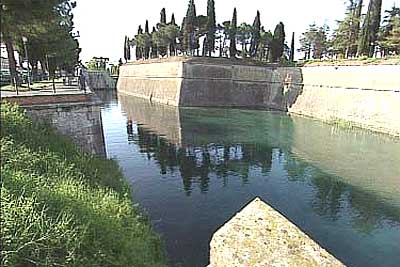
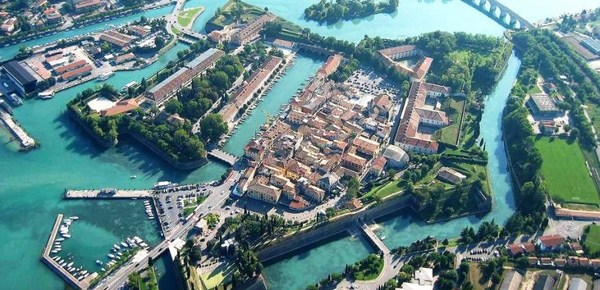
On 30th May the historic, moated, fortress of Peschiera fell from Austrian control following on from a protracted debilitating siege and weeks of bombardment, having received some forty thousand cannon balls aimed at the its defences, by forces under Piedmontese direction.
An aerial view of the one-time fortress in more recent times showing its uses for leisure, including a marina.
In June Radetzky's forces were further reinforced with an additional 20,000 soldiers that had crossed on foot through the Alpine passes. By mid-June the Emperor and his advisors, attempting to cope with the turmoil then widespread across the Habsburg Empire, came to see merit in attempting to bring an end to an expensive war by securing a ceasefire with Piedmont and entering into negotiations over the status of Lombardy. Radetzky was urged to seek to achieve a ceasefire preparatory to such negotiations.
In the event Radetzky questioned these orders sending an high ranking colleague, Prince Felix Schwarzenberg, to Innsbruck to implore the Emperor to trust to the valour of his soldiers and to continue the combat.
In early July the previously independence-minded city of Venice, (where a Republic of St. Mark had been proclaimed), itself voted for annexation to the Piedmontese-Sardinian kingdom as it then being blockaded by the Austrian navy and generally felt itself to be seriously threatened by an evident resurgence in Austrian power.
Giuseppe Garibaldi, who had been obliged to leave Marseilles in 1834 in the wake of a failed "Young Italianist" conspiracy and who had subsequently won a reputation as a populist liberator in the South Americas, was kept regularly informed by mail of developments in Europe by Mazzini who, as the early events of 1848 unfolded, encouraged Garibaldi to return to Europe to participate personally, in the furthering the "Young Italian", republican, agenda of reform.
Mazzini considered that Garibaldi's fame as a populist liberator would assist in the taking advantage of opportunities that might arise in the ongoing situation where popular aspirations for change were often bearing fruit in the form of unprecedented concessions being made by various European state governments.
After making port in his home town of Nice, Garibaldi, together with some eighty battle-proven associates who had voyaged with him, assessed the latest news of developments and decided to set aside their usual republicanism and to offer assistance to King Charles Albert who could be seen as having become a "defender of the people's cause".
Garibaldi actually arrived in the camp of King Charles Albert in early July, 1848, but Charles Albert, largely to avoid criticisms from other European sovereigns, sought to maintain some distance from such radicalist notoriety as clung to Garibaldi, by offering him hopes of employment in the Piedmontese-Sardinian capital, Turin, rather than on the battlefield.
In the event Garibaldi was to be found shortly thereafter in Milan where he found a welcome with Mazzini and others and was awarded the official rank of major-general in the Lombard army.
Although the assemblies of several Italian territories had voted for annexation to the Kingdom of Piedmont-Sardinia this was not put into effect as the Austrian commander Radetzky exceeded his official orders by leading his now reinforced armies based in the Quadrilateral against the Piedmontese-Sardinian led interest and won a decisive victory at Custozza on July 23rd.
Charles Albert withdrew his forces towards Milan hoping to offer that city protection with the aid of stocks of provisions he expected to find there and, indeed, the aid of the Milanese themselves. Upon his arrival Charles Albert, who had taken significant strategic risks in opting to attempt to defend Milan, found the stocks of provisions he had hoped for to be largely absent although local republicans, upon hearing of the reverse suffered at Custozza, had attempted to recover, in a very few days, from the absence of any serious preparations for defence of their city being made by the Milanese over the previous weeks.
By August 5 an armistice was agreed between the Austrians and the Piedmontese-Sardinians who offered no further resistance.
The outcome at Custozza was of major significance as it contributed to the emergence of confidence amongst the higher reaches of the Habsburg court that the Habsburg system could withstand the various challenges with which it was faced. Men and resources that had been allocated for service in the Italian peninsula could now, potentially, be re-assigned in efforts to contain turmoil in other regions of the Habsburg Monarchy.
Major-general Garibaldi, and some 3000 followers, however, remained in the field although increasingly suffering desertions of, eventually, some two thousand individuals who gradually sought the safety, and relative comfort, of exile across the nearby borders of Switzerland. Mazzini, and some of his own associates, were amongst those who left Milan with Garibaldi and who thereafter shared in diverse privations and dangers, for a time, before making their way to Switzerland.
After gaining a couple of significant victories, given the size of their forces, Garibaldi and his remaining followers were themselves obliged to seek Swiss exile in late August, 1848, after Radetzky sent six full brigades against them.
Mazzini soon thereafter launched two small, and short-lived, armed incursions from Switzerland into Italian territories hoping to foment a more general rising in favour of his own preferred republican form of Italian liberty.
Garibaldi returned to Nice but hoped to find further opportunities for aiding what he saw as the cause of Italian freedom. He left Nice turning up in traditionally radical Genoa where, in late September, he received an invitation to intervene in Sicily. His plans changed, however, during a voyage towards that island and another opportunity to intervene, in Venice, was also abandoned after some dramatic developments in Rome.
On 15 November, Pellegrino Rossi, who had been attempting as a nominee of the Papal administration, but without much local political support, to serve as a somewhat liberal prime minister in Rome, was assassinated.
Pellegrino Rossi's position had been one of attempting to steer a conciliatory middle course between polarised clericals and radicals and he had met his fate at the hands of radicals who objected to the relative conservatism of his political outlook.
Radicals began to exercise a decisive political sway in the city and, on 24 November, Pope Pius IX went into voluntary exile seeking the protection of the King Of Naples. A king whom the radicals in Rome viewed as being a hopeless reactionary!
During these times Garibaldi wrote to the Committee set up by the Roman radicals and subsequently received an offer of employment for himself and for his associates which soon led Garabaldi and his remaining 400 or so Garabaldini comrades to proceed overland in a southerly direction.
Their intended destination was not Rome but was a provincial territory of what had, until recently, been the States of the Church in relation to which the radicalist Committee just established in Rome were concerned about a possible clerically supported challenge to its authority.
A specific section treating with the subsequent developments in Rome is available here
Details of developments occurring more widely in Europe are to be found on our Widespread social chaos allows the re-assertion of Dynastic / Governmental Authority page.
Just twelve years after the tumults of 1848-1849 "Italia" was brought to a large degree of political unity by the
statecraft of Cavour, chief minister to the King of Piedmont-Sardinia, who actually received support from Italian Republicans!!!!
In efforts to attain a more acceptable existence for "Italy" and "Italians" it came to be that the Tuscan / Florentine dialect utilised to great literary effect several centuries earlier by Dante and others was adopted as being The Italian Language and was taught as such in schools widely across Italia despite the existence, and widespread everyday usage, of numerous well-established regional languages!!!
After 1861 the Kingdom of Italy operated under a "Tricolore Italiano" as first sponsored by King Charles Albert in 1848.
- The European Revolutions of 1848 begin
- A broad outline of the background to the onset of the turmoils and a consideration of some of the early events in
Paris, Berlin, Vienna, Budapest and Prague.
- The French Revolution of 1848
- A particular focus on France - as the influential Austrian minister Prince Metternich, who sought to encourage the re-establishment of "Order" in the wake of the French Revolutionary and Napoleonic turmoil of 1789-1815, said:-"When France sneezes Europe catches a cold".
- The "Italian" Revolution of 1848
- A "liberal" Papacy after 1846 helps allow the embers of an "Italian" national aspiration to rekindle across the Italian Peninsula.
- The Revolution of 1848 in the German Lands and central Europe
- "Germany" (prior to 1848 having been a confederation of thirty-nine individually sovereign Empires, Kingdoms, Electorates, Grand Duchies, Duchies, Principalities and Free Cities), had a movement for a single parliament in 1848 and many central European would-be "nations" attempted to promote a distinct existence for their "nationality".
- Widespread social chaos allows the re-assertion of Dynastic / Governmental Authority
- Some instances of social and political extremism allow previously pro-reform liberal elements to join conservative elements in supporting
the return of traditional authority. Such nationalities living within the Habsburg Empire as the Czechs, Croats, Slovaks, Serbs and Romanians,
find it more credible to look to the Emperor,
rather than to the democratised assemblies recently established in Vienna and in Budapest as a result of populist agitation, for the future protection
of their nationality.
The Austrian Emperor and many Kings and Dukes regain political powers. Louis Napoleon, (who later became the Emperor Napoleon III), elected as President in France offering social stability at home but ultimately follows policies productive of dramatic change in the wider European structure of states and their sovereignty.
Other Popular European History pages
at Age-of-the-Sage
The preparation of these pages was influenced to some degree by a particular "Philosophy
of History" as suggested by this quote from the famous Essay "History" by Ralph Waldo Emerson:-
There is one mind common to all individual men...
Of the works of this mind history is the record. Its genius is illustrated by the entire series of days. Man is explicable by nothing less than all his history. Without hurry, without rest, the human spirit goes forth from the beginning to embody every faculty, every thought, every emotion, which belongs to it in appropriate events. But the thought is always prior to the fact; all the facts of history pre-exist in the mind as laws. Each law in turn is made by circumstances predominant, and the limits of nature give power to but one at a time. A man is the whole encyclopaedia of facts. The creation of a thousand forests is in one acorn, and Egypt, Greece, Rome, Gaul, Britain, America, lie folded already in the first man. Epoch after epoch, camp, kingdom, empire, republic, democracy, are merely the application of his manifold spirit to the manifold world.
Of the works of this mind history is the record. Its genius is illustrated by the entire series of days. Man is explicable by nothing less than all his history. Without hurry, without rest, the human spirit goes forth from the beginning to embody every faculty, every thought, every emotion, which belongs to it in appropriate events. But the thought is always prior to the fact; all the facts of history pre-exist in the mind as laws. Each law in turn is made by circumstances predominant, and the limits of nature give power to but one at a time. A man is the whole encyclopaedia of facts. The creation of a thousand forests is in one acorn, and Egypt, Greece, Rome, Gaul, Britain, America, lie folded already in the first man. Epoch after epoch, camp, kingdom, empire, republic, democracy, are merely the application of his manifold spirit to the manifold world.